
Gerund or infinitive exercises: ejercicios con soluciones y PDF
¿Por qué decimos enjoy reading pero want to read? En esta guía aprenderás a elegir la forma adecuada mediante explicaciones, ejemplos y práctica progresiva. Los gerund or infinitive exercises incluyen actividades para niveles B1, B2 y C1.
Puedes utilizar los ejercicios de relative clauses para estudiar por tu cuenta, reforzar lo aprendido en clase o preparar pruebas de nivel y exámenes Cambridge. Los ejemplos avanzan desde estructuras básicas hasta usos formales de nivel superior.
Aprende inglés con Inglaterra en Casa
En Inglaterra en Casa reforzamos la gramática mediante clases presenciales participativas con profesores nativos, actividades prácticas y preparación de Cambridge. También organizamos programas intensivos y propuestas de inmersión en inglés para niños y jóvenes. Consulta nuestras opciones formativas en Valencia y Mislata.
Qué son el gerundio y el infinitivo
El gerundio inglés se forma con la terminación -ing y puede funcionar como sujeto o complemento: Reading helps me relax (Leer me ayuda a relajarme). El infinitivo con to se construye con to y la forma base: I hope to improve (Espero mejorar). También existe el infinitivo sin to: You must practise. No toda forma en -ing es un gerundio: en She is reading forma parte de un tiempo continuo. No traduzcas automáticamente el gerundio inglés por el gerundio español; a menudo se traduce por un infinitivo.
Cómo formar las estructuras
En general, añade -ing: work → working. Elimina la e muda: write → writing; cambia ie por y: lie → lying; duplica la consonante final cuando corresponda: run → running. En inglés británico se escribe travelling. Para negar estas formas utiliza not: not going, not to go. El verbo principal determina el tiempo: She enjoyed dancing y She enjoys dancing mantienen dancing.
Verbos seguidos de gerundio
Enjoy, avoid, admit, deny, consider, finish, mind, miss, postpone, practise, recommend, suggest, risk, keep, imagine y give up suelen exigir -ing cuando van seguidos directamente de otro verbo. I avoid driving at night (Evito conducir de noche). She suggested taking a taxi (Sugirió coger un taxi). Suggest también admite una oración con that: She suggested that we take a taxi. No se usa suggest to take en este patrón.
Verbos seguidos de infinitivo
Agree, afford, decide, expect, hope, learn, manage, offer, plan, promise, refuse, seem, tend, want y wish admiten to + verbo. We managed to catch the train (Conseguimos coger el tren). El infinitivo suele expresar un objetivo, decisión o expectativa, pero esta tendencia no sustituye el aprendizaje del patrón de cada verbo. Would like, would love y would prefer normalmente llevan to + infinitivo.
Preposiciones y expresiones fijas
Después de una preposición, si aparece un verbo, normalmente adopta -ing: after eating, without asking, interested in learning. En look forward to, be used to y object to, to es una preposición, no la marca del infinitivo. I am used to getting up early significa que estoy acostumbrado a madrugar; I used to get up early describe un hábito pasado. También se usa -ing con it is worth, cannot help y have difficulty.
Infinitivo de finalidad, adjetivos y objetos
I went to the library to study expresa finalidad. Es habitual usar infinitivo después de ready, eager, difficult y happy: I am ready to leave. Con ask, tell, persuade, encourage, remind y invite se usa objeto + to + verbo: They encouraged us to speak. Allow y advise admiten -ing sin objeto personal: They allow parking; con objeto: They allow visitors to park.
Infinitivo sin to
Después de los modales can, could, may, might, must, should y will se utiliza la forma base. Let y make en activa llevan objeto + infinitivo sin to: Let me explain; They made us wait. En pasiva, make recupera to: We were made to wait. Help admite ambas formas: Help me carry this o Help me to carry this. See, hear y watch con objeto permiten forma base para presentar el evento completo o -ing para destacar su desarrollo.
Verbos que admiten ambas formas
Begin, start y continue suelen admitir ambas formas con escasa diferencia: It started raining / to rain. Like, love, hate y prefer también pueden admitirlas; -ing suele destacar la actividad y el infinitivo puede destacar una elección o hábito. I like swimming frente a I like to check my diary before work. No conviertas estas preferencias en reglas absolutas. Prefer reading to watching TV utiliza to como preposición; prefer to read rather than watch TV utiliza otra estructura.
Formas avanzadas: pasiva y anterioridad
La forma pasiva del gerundio es being + participio: She dislikes being interrupted. La del infinitivo es to be + participio: He hopes to be selected. Having + participio y to have + participio expresan anterioridad: He denied having copied the notes; She seems to have lost her key. Need puede admitir -ing con sentido pasivo: The windows need cleaning equivale a The windows need to be cleaned.
Estrategia para resolver los ejercicios
Identifica primero el verbo o la expresión que gobierna el complemento. Comprueba si existe una preposición, un modal o un objeto personal. Si las dos formas son posibles, interpreta el contexto: ¿es una experiencia recordada, una obligación pendiente, un intento o una prueba? Finalmente revisa la ortografía. Aprende los patrones con frases completas y no con traducciones aisladas.
Gerund or infinitive: verbos que cambian de significado
| Verbo | -ing | to + infinitive |
|---|---|---|
| stop | dejar una actividad. She stopped eating sweets. | detenerse para otra finalidad. She stopped to buy bread. |
| remember | recordar una experiencia. I remember visiting York. | acordarse de realizar una tarea. Remember to charge your phone. |
| forget | olvidar una experiencia vivida. I will never forget seeing the sea. | olvidar realizar una tarea. I forgot to send the form. |
| try | probar un método. Try adding more water. | esforzarse por conseguir algo. I tried to lift the box. |
| regret | lamentar una acción pasada. I regret saying that. | comunicar algo lamentable formalmente. We regret to announce the closure. |
| mean | implicar. The job means travelling. | tener intención. I meant to reply. |
| go on | continuar la misma acción. He went on reading. | pasar a otra acción. He went on to discuss costs. |
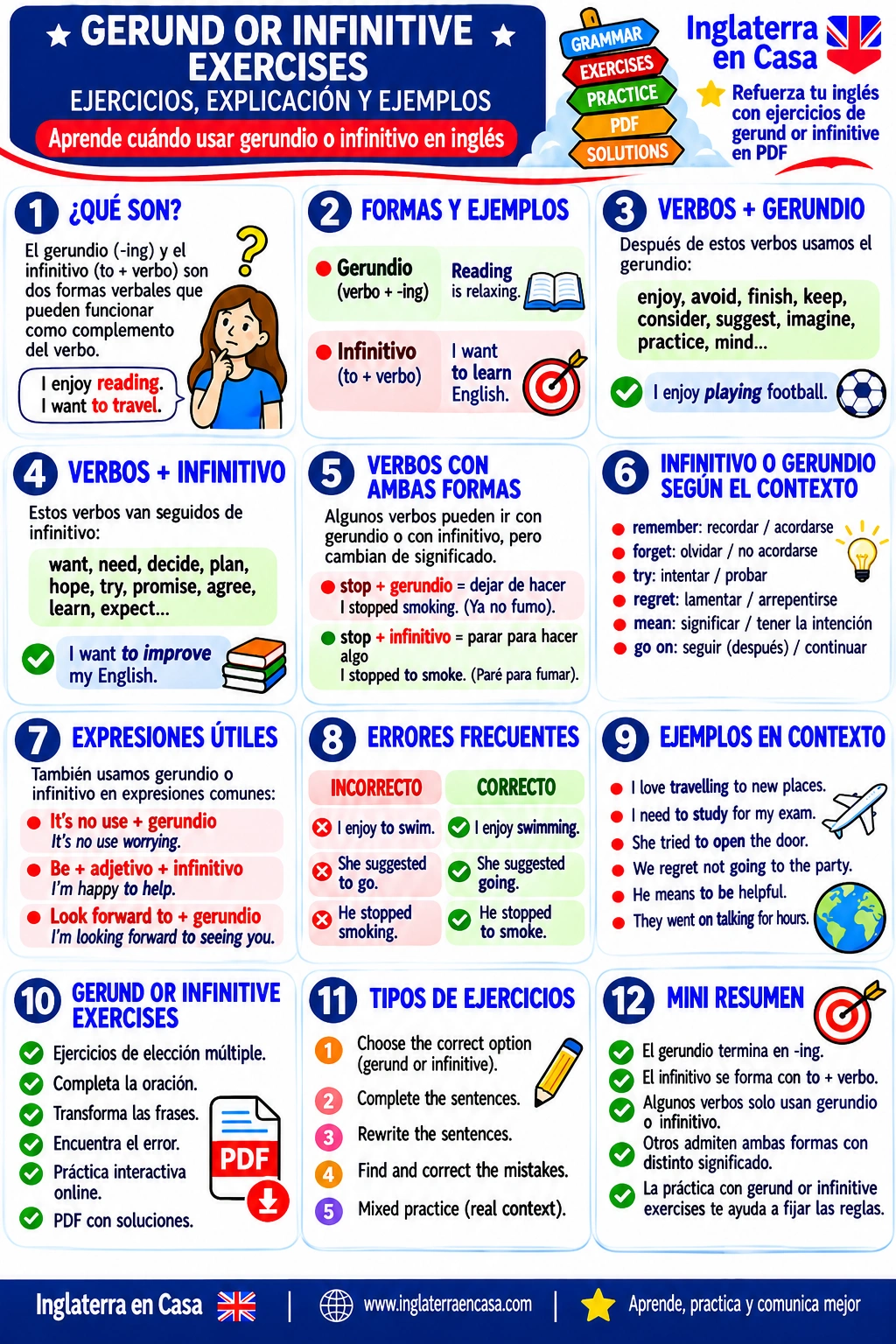
Gerund or infinitive exercises en PDF
La ficha descargable reúne las explicaciones y los 80 ejercicios con respuestas. Haz primero los bloques sin consultar las soluciones y repite aquellos en los que tengas dudas.
Bloque 1. Completa con -ing
- I enjoy ___ (paint) landscapes.
- She avoided ___ (mention) the accident.
- We finished ___ (pack) at midnight.
- He admitted ___ (break) the cup.
- They denied ___ (take) the money.
- Would you mind ___ (close) the window?
- I miss ___ (live) near the coast.
- We considered ___ (move) abroad.
- She suggested ___ (meet) on Friday.
- He risks ___ (lose) his deposit.
- Keep ___ (write) until the bell rings.
- They postponed ___ (open) the shop.
- I cannot imagine ___ (work) there.
- She gave up ___ (eat) meat.
- He practises ___ (speak) every morning.
- I am interested in ___ (learn) Welsh.
- They left without ___ (say) goodbye.
- We look forward to ___ (see) you.
- This museum is worth ___ (visit).
- She is used to ___ (drive) on the left.
Bloque 2. Completa con infinitivo, con o sin to
- We decided ___ (rent) a flat.
- He hopes ___ (pass) the exam.
- She promised ___ (return) the book.
- They refused ___ (sign) the agreement.
- I cannot afford ___ (replace) the laptop.
- He managed ___ (solve) the puzzle.
- We agreed ___ (share) the costs.
- She offered ___ (carry) my bag.
- I expect ___ (arrive) before noon.
- They plan ___ (visit) Scotland.
- He learned ___ (swim) last summer.
- She seems ___ (know) the answer.
- I would like ___ (order) soup.
- We are ready ___ (begin).
- He went outside ___ (get) some air.
- She reminded me ___ (bring) my ID.
- They invited us ___ (join) the team.
- The coach encouraged him ___ (train) regularly.
- You must ___ (wear) a helmet.
- Let her ___ (choose) the colour.
Bloque 3. El contexto y las formas avanzadas
- I stopped ___ (drink) coffee permanently.
- On our walk we stopped ___ (admire) the view.
- I remember ___ (ride) that horse as a child.
- Remember ___ (switch) off the oven tonight.
- I forgot ___ (attach) the file, so the email had no attachment.
- I will never forget ___ (hear) that concert.
- Try ___ (use) a different browser as a possible solution.
- He tried ___ (reach) the shelf but was too short.
- I regret ___ (sell) my old bicycle.
- We regret ___ (inform) you that the event is cancelled.
- Working here means ___ (travel) every week.
- I meant ___ (call), but I got distracted.
- She went on ___ (talk) about the same subject for an hour.
- After explaining the rules, he went on ___ (introduce) the teams.
- I dislike ___ (interrupt) by other people. (Passive)
- He hopes ___ (promote) next year. (Passive)
- The roof needs ___ (repair). Use the -ing form.
- She seems ___ (finish) already. Use the perfect infinitive.
- They denied ___ (receive) the letter before the meeting. Use the perfect -ing form.
- We were made ___ (wait) outside.
Bloque 4. Encuentra el error
- She enjoys to dance.
- He decided leaving early.
- We avoided to answer.
- I hope seeing you soon.
- They suggested to walk home.
- She must to study tonight.
- Let him to speak.
- I look forward to hear from you.
- He is good at solve puzzles.
- They promised helping us.
- We finished to clean the kitchen.
- She refused paying the bill.
- He left without to apologise.
- I cannot afford buying a car.
- She reminded me sending the letter.
- They made us to run.
- We were made run.
- I am used to wake up early.
- He admitted to steal the wallet.
- It is worth to read this article.
Ejercicios interactivos
Preguntas frecuentes sobre «Gerund or infinitive exercises»
¿Cómo sé si un verbo lleva gerundio o infinitivo?
Aprende el patrón del verbo principal y comprueba si hay una preposición, un modal o un objeto. Si admite ambas formas, analiza el significado.
¿Se utiliza siempre infinitivo después de to?
No. En look forward to y be used to, to es una preposición y exige -ing si le sigue un verbo.
¿Cuál es la diferencia entre stop doing y stop to do?
Stop doing indica que se abandona una actividad; stop to do indica que se interrumpe otra actividad para realizar una nueva.
¿Puedo utilizar like con las dos formas?
Sí. Like admite -ing y to + infinitivo. La elección puede destacar el disfrute de una actividad o una preferencia habitual.
¿Qué forma se utiliza después de un modal?
Con los modales centrales como can, must y should se utiliza el infinitivo sin to.
¿Para qué nivel sirven estos gerund or infinitive exercises?
Los ejercicios están dirigidos principalmente a B1 y B2, con estructuras avanzadas útiles para C1.
¿Puedo practicar sin conexión?
Sí. El PDF incluye la teoría, 80 ejercicios y las soluciones al final.
Soluciones de los ejercicios
Bloque 1. Completa con -ing
- painting
- mentioning
- packing
- breaking
- taking
- closing
- living
- moving
- meeting
- losing
- writing
- opening
- working
- eating
- speaking
- learning
- saying
- seeing
- visiting
- driving
Bloque 2. Completa con infinitivo, con o sin to
- to rent
- to pass
- to return
- to sign
- to replace
- to solve
- to share
- to carry
- to arrive
- to visit
- to swim
- to know
- to order
- to begin
- to get
- to bring
- to join
- to train
- wear
- choose
Bloque 3. El contexto y las formas avanzadas
- drinking
- to admire
- riding
- to switch
- to attach
- hearing
- using
- to reach
- selling
- to inform
- travelling
- to call
- talking
- to introduce
- being interrupted
- to be promoted
- repairing
- to have finished
- having received
- to wait
Bloque 4. Encuentra el error
- She enjoys dancing.
- He decided to leave early.
- We avoided answering.
- I hope to see you soon.
- They suggested walking home.
- She must study tonight.
- Let him speak.
- I look forward to hearing from you.
- He is good at solving puzzles.
- They promised to help us.
- We finished cleaning the kitchen.
- She refused to pay the bill.
- He left without apologising.
- I cannot afford to buy a car.
- She reminded me to send the letter.
- They made us run.
- We were made to run.
- I am used to waking up early.
- He admitted stealing the wallet.
- It is worth reading this article.
Sigue aprendiendo inglés con Inglaterra en Casa
Completa tu aprendizaje con nuestros ejercicios de gramática B1, ejercicios de gramática B2 y ejercicios de gramática C1. En nuestros cursos presenciales de inglés en Valencia puedes practicar estas estructuras con profesores nativos. Los jóvenes también pueden disfrutar del campus de fútbol en inglés.