
Ejercicios gramática inglés B2 online en PDF y con soluciones
Los ejercicios de gramática en inglés B2 online permiten dar un paso importante entre el nivel intermedio y un uso más flexible del idioma. En B2 ya no basta con conocer una regla: el alumno necesita elegir entre estructuras parecidas, interpretar matices, relacionar tiempos verbales y producir frases más precisas en situaciones reales.
Esta guía combina explicación, ejemplos, práctica escrita, ejercicios interactivos y un PDF con soluciones. Los ejercicios de gramática en inglés B2 online están pensados para repasar de forma variada los contenidos que suelen generar más dudas: tiempos perfectos, futuros, condicionales, modales perfectos, voz pasiva, estilo indirecto, relativas, gerundios e infinitivos, estructuras causativas, inversión y conectores. Estos ejercicios en PDF son diferentes a los que encontrarás en esta publicación de esta maneras aumentamos tu batería de ejercicios.
¿Buscas ejercicios de gramática de inglés de nivel B1 online en PDF y con soluciones?
Recientemente hemos publicado sobre esto. Te facilitamos el enlace a continuación: Ejercicios de gramática online de inglés de nivel B1 online en PDF y con soluciones.
Qué se trabaja en estos ejercicios gramática inglés B2 online
La gramática de nivel B2 amplía muchas estructuras vistas en B1 y exige utilizarlas con mayor precisión. Los ejercicios de esta página mezclan forma y significado para que el alumno no responda únicamente por memoria, sino que tenga que interpretar el contexto antes de decidir.
Present perfect simple y present perfect continuous
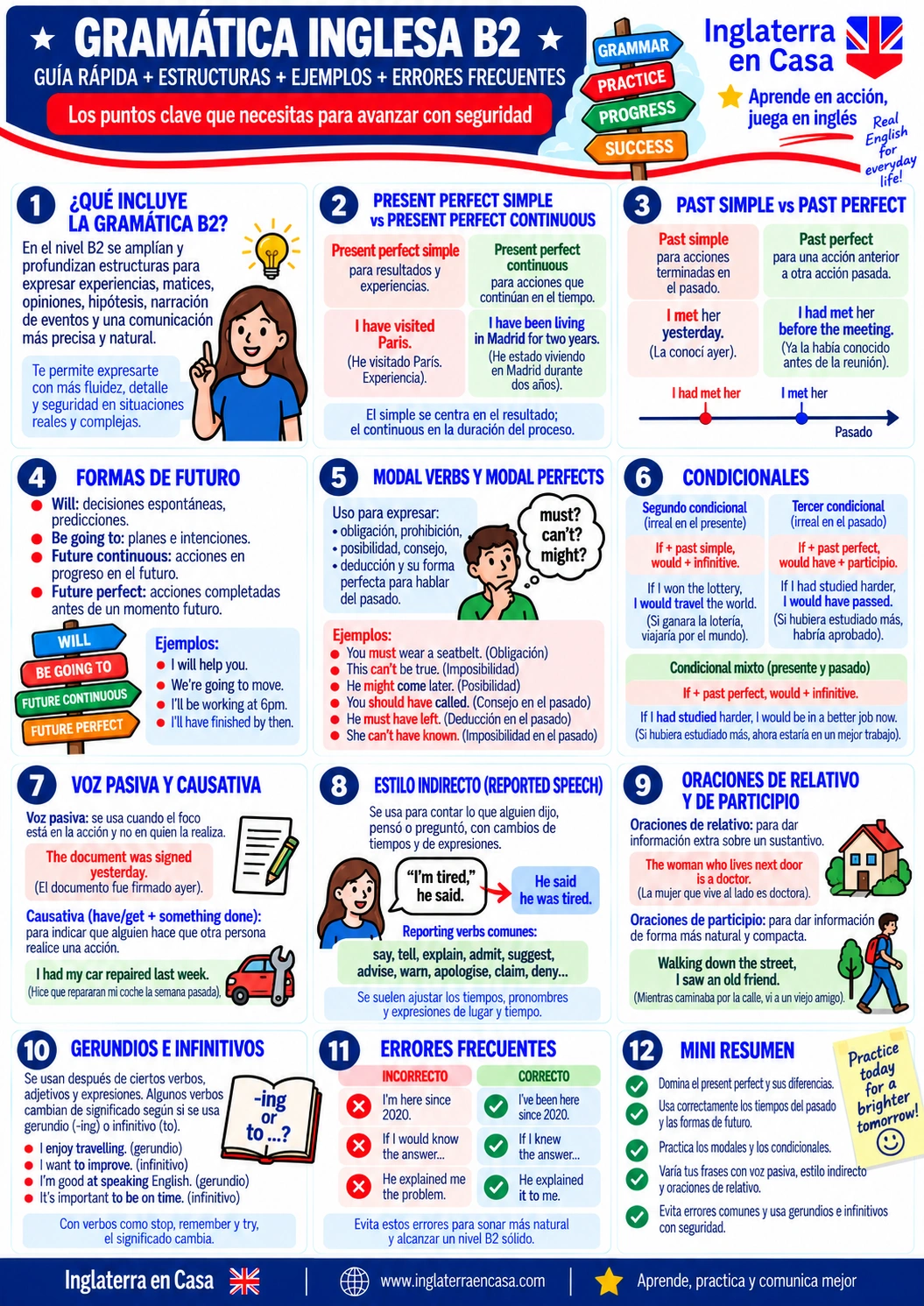
El present perfect simple suele centrarse en el resultado, la cantidad o una experiencia completada: I have written three emails. El present perfect continuous pone el foco en la duración o en una actividad que se ha desarrollado durante un periodo: I have been writing emails all morning. La diferencia depende de qué información quiere destacar el hablante.
Past perfect simple y past perfect continuous
El past perfect simple sitúa una acción anterior a otro momento del pasado: When we arrived, the film had started. El past perfect continuous destaca la duración de una actividad anterior: She had been studying for hours before the exam began. En narraciones B2, combinar ambos tiempos aporta claridad temporal.
Formas de futuro y future perfect
En B2 se amplía el contraste entre will, be going to, presente continuo y presente simple con valor futuro. También aparece el future continuous para acciones en progreso en un momento futuro (This time tomorrow, I will be flying to Rome) y el future perfect para acciones terminadas antes de un punto futuro (By Friday, we will have finished the report).
Condicionales mixtos y third conditional
El third conditional habla de situaciones irreales del pasado: If I had known, I would have called you. Los mixed conditionals conectan tiempos diferentes cuando una causa pasada tiene una consecuencia presente o una situación presente habría producido un resultado pasado: If I had gone to bed earlier, I wouldn’t be so tired now.
Wish, if only y estructuras para situaciones hipotéticas
Wish e if only permiten expresar deseos, arrepentimientos o quejas. Para situaciones presentes usamos normalmente pasado: I wish I had more time. Para arrepentimientos sobre el pasado usamos had + participle: If only I had studied harder. Para quejas sobre conductas repetidas puede aparecer would: I wish he would stop interrupting.
Modal verbs y modal perfects
Además de must, have to, should, might y could, B2 trabaja combinaciones como must have + participle para deducción sobre el pasado, might have + participle para posibilidad y should have + participle para expresar crítica o una acción que habría sido recomendable: You should have told me earlier.
Voz pasiva y estructuras pasivas avanzadas
La pasiva puede aparecer en distintos tiempos: The decision has been announced, The road is being repaired o The work will have been completed by June. En B2 también son útiles las estructuras impersonales: It is believed that… y He is said to…, frecuentes en textos formales y noticias.
Have/get something done: causative
La estructura have/get + objeto + participio indica que otra persona realiza un servicio para nosotros: I had my hair cut yesterday. No significa que el sujeto hiciera personalmente la acción. Los ejercicios de gramática en inglés B2 online ayudan a diferenciar esta estructura de la pasiva normal.
Reported speech, reporting verbs y preguntas indirectas
En estilo indirecto aparecen cambios de tiempo, pronombres y expresiones temporales. En B2 se amplía el repertorio de verbos: admit doing, deny doing, advise someone to do, warn someone not to do, suggest doing. Las preguntas indirectas conservan orden afirmativo: Could you tell me where the station is?, no where is the station.
Relative clauses y participle clauses
Las relativas definitorias y explicativas requieren controlar pronombres, comas y omisión del relativo. B2 introduce también reducciones: The people waiting outside are students o The documents sent yesterday have arrived. Estas formas hacen el texto más compacto y natural.
Gerunds, infinitives y cambios de significado
Algunos verbos admiten gerundio o infinitivo con diferencias de significado. Remember to call significa recordar que hay que llamar; remember calling significa recordar el hecho de haber llamado. También son importantes stop doing / stop to do, try doing / try to do y regret doing / regret to inform.
Inversión, énfasis y conectores B2
La inversión aparece después de expresiones negativas o restrictivas en registros formales: Never have I seen such a view; Not only did she apologise, but she also paid for the damage. A este nivel también se espera un uso preciso de conectores como although, despite, however, whereas, provided that, unless, in spite of y so that.
Cómo aprovechar los ejercicios de gramática en inglés B2 online
Conviene trabajar los bloques sin mirar las soluciones, marcar las respuestas dudosas y revisar después la regla que explica cada error. Cuando una respuesta sea incorrecta, es útil escribir un ejemplo propio con la misma estructura. Así los ejercicios de gramática en inglés B2 online se convierten en práctica activa y no en una simple comprobación.
Otra estrategia eficaz es alternar tipos de ejercicio. Completar formas verbales entrena la construcción; transformar frases obliga a reconocer equivalencias; la elección múltiple trabaja matices; y la corrección de errores ayuda a detectar formas que pueden parecer naturales pero no son correctas. Esta variedad refleja mejor las exigencias reales del nivel B2.
Ejercicios de gramática en inglés B2 online: práctica completa
Los cuatro bloques siguientes reúnen 80 actividades. Las soluciones se encuentran después de las preguntas frecuentes para que puedas practicar sin ver las respuestas antes de tiempo.
Bloque 1: completa con la forma correcta
- I ___ (work) on this report all morning and I still haven’t finished.
- By the time we arrived, the concert ___ already ___ (start).
- She ___ (wait) for over an hour before the bus finally came.
- By next June, they ___ (live) here for ten years.
- This time tomorrow, I ___ (sit) on a beach.
- If you ___ (tell) me earlier, I would have helped.
- If I had taken that job, I ___ (live) in Berlin now.
- I wish I ___ (not spend) so much money last weekend.
- If only he ___ (listen) to our advice more often.
- She looks exhausted. She ___ (work) all night.
- You ___ (tell) me you were coming; I would have prepared dinner.
- The new sports centre ___ (open) by the mayor next week.
- The road ___ (repair) at the moment, so expect delays.
- By the end of the month, all applications ___ (process).
- I ___ my laptop ___ (repair) yesterday.
- He denied ___ (take) the money.
- The teacher advised us ___ (revise) the vocabulary.
- Do you know where she ___ (live)?
- The people ___ (stand) near the entrance are waiting for tickets.
- Never ___ I ___ (see) such an impressive performance.
Bloque 2: reescribe sin cambiar el significado
- I didn’t study enough, so I failed the exam. (IF)
- I regret not accepting the offer. (WISH)
- Perhaps Sara forgot about the meeting. (MIGHT)
- I’m sure Tom was at home because his car was outside. (MUST)
- Someone is repairing our roof this week. (HAVING)
- People believe that the painting is authentic. (BELIEVED)
- ‘Don’t touch that wire,’ the engineer said to us. (WARNED)
- ‘Why don’t we take a taxi?’ Laura said. (SUGGESTED)
- Where is the nearest pharmacy? Could you tell me…?
- The woman is my neighbour. She won the prize. (WHO)
- The documents were sent yesterday. They are confidential. (SENT)
- I started learning English five years ago. (FOR)
- I last saw Daniel in March. (SINCE)
- It’s possible that they took the wrong train. (MAY)
- It wasn’t necessary for you to buy any food. (NEEDN’T)
- As soon as I arrived, I called her. (HARDLY)
- She not only speaks Japanese, but she also writes it. (ONLY)
- Although he was tired, he continued working. (DESPITE)
- We can go hiking if the weather stays dry. (PROVIDED)
- I stopped because I wanted to buy some water. (TO)
Bloque 3: elige la opción correcta
- I ___ this book for two weeks, but I haven’t finished it yet.
A) have read B) have been reading C) had read - By 8 p.m., we ___ the presentation.
A) will finish B) will have finished C) are finishing - If she had left earlier, she ___ the train.
A) would catch B) would have caught C) will have caught - If I were more organised, I ___ so stressed yesterday.
A) wouldn’t have been B) won’t be C) hadn’t been - I wish you ___ your phone during meetings.
A) wouldn’t check B) didn’t checked C) haven’t checked - He isn’t answering. He ___ his phone at home.
A) must leave B) might have left C) should leave - You ___ so fast; the road was icy.
A) shouldn’t have driven B) mustn’t drive C) didn’t have to drive - The suspect is believed ___ the country.
A) to have left B) leaving C) that he left - I’m ___ my eyes tested tomorrow.
A) having B) making C) doing - She admitted ___ the confidential file.
A) to open B) opening C) open - He reminded me ___ the door.
A) locking B) to lock C) lock - Could you tell me what time the museum ___?
A) does close B) closes C) is close - The man ___ next to the window is my uncle.
A) sitting B) sat C) who sitting - This is the company ___ products are sold worldwide.
A) which B) whose C) where - I remember ___ that film when I was a child.
A) to see B) seeing C) see - Remember ___ the lights before you leave.
A) turning off B) to turn off C) turn off - Never ___ such a difficult decision.
A) I have made B) have I made C) did I made - ___ the bad weather, the match continued.
A) Although B) Despite C) However - You can borrow my car ___ you bring it back by six.
A) provided that B) despite C) whereas - She whispered ___ nobody would hear her.
A) so that B) despite C) unless
Bloque 4: encuentra el error
Todas las frases siguientes contienen un error. Corrígelo antes de consultar las soluciones.
- I have been knowing her for ten years.
- By next week, I will finish the project.
- If I would have known, I would have called.
- If I had more time yesterday, I would have helped you.
- I wish I would know the answer.
- You must have to left your keys at work.
- You should have to told me earlier.
- The new bridge is being build now.
- He is said that he lives abroad.
- I had my car to repair yesterday.
- She suggested us to leave early.
- He warned me don’t touch the switch.
- Can you tell me where is the station?
- My brother, that lives in Leeds, is a doctor.
- The people waited outside were getting impatient.
- I stopped to smoke two years ago.
- I remember to meet her at university.
- Never I have seen such a beautiful place.
- Despite it was raining, we went out.
- Unless you don’t hurry, you’ll be late.
Ejercicios interactivos
Ejercicios interactivos de gramática B1
Selecciona una opción en cada pregunta. El bloque funciona únicamente con HTML y CSS: no utiliza JavaScript.
1. Tiempos verbales
2. Modales y significado
3. Transformaciones B1
4. Condicionales y conectores
5. Precisión y errores frecuentes
Preguntas frecuentes
¿Qué contenidos de gramática se esperan en un nivel B2?
En B2 se consolidan los tiempos verbales y se amplían estructuras como perfect tenses, condicionales, modales perfectos, pasiva, estilo indirecto, relativas, gerundios e infinitivos, causative, inversión y conectores complejos.
¿Cómo conviene trabajar los ejercicios de gramática en inglés B2 online?
Lo más útil es resolver primero cada bloque sin ayuda, revisar después los errores y crear ejemplos propios con las estructuras que hayan generado dudas.
¿Los ejercicios B2 sirven para preparar exámenes oficiales?
Sí, ayudan a reforzar la precisión gramatical necesaria en tareas de nivel B2, aunque conviene combinarlos con práctica específica de reading, writing, listening y speaking del examen que se vaya a realizar.
¿Qué diferencia hay entre B1 y B2 en gramática?
En B2 aumenta la variedad de estructuras, la precisión y la capacidad de elegir entre formas similares según el contexto. También aparecen combinaciones más complejas de tiempos y estructuras.
¿Cuándo se usa el third conditional?
Se utiliza para imaginar un resultado diferente de una situación pasada que ya no puede cambiarse: If I had known, I would have called you.
¿Qué son los modal perfects?
Son estructuras como must have done, might have done o should have done. Permiten expresar deducción, posibilidad, crítica o valoración sobre hechos pasados.
¿Qué significa have something done?
Indica que otra persona realiza un servicio para el sujeto, por ejemplo I had my car repaired. El sujeto organiza o recibe el servicio, pero no ejecuta la acción personalmente.
¿Dónde están las soluciones de los ejercicios?
Las soluciones aparecen al final de esta página, después de las preguntas frecuentes, y también se incluyen en el PDF descargable.
Ejercicios interactivos de gramática B2
Selecciona una respuesta en cada pregunta. El propio CSS mostrará inmediatamente si la opción es correcta o incorrecta. Este bloque no utiliza JavaScript.
1. Perfect tenses y futuros
2. Condicionales, wish y modales
3. Pasiva, causative y reporting verbs
4. Relativas, gerundios e inversión
5. Conectores y precisión B2
Soluciones de los ejercicios de gramática B2
Bloque 1
- have been working
- had already started
- had been waiting
- will have lived
- will be sitting
- had told
- would be living / would live
- hadn't spent
- would listen
- must have been working
- should have told
- will be opened
- is being repaired
- will have been processed
- had / repaired
- taking
- to revise
- lives
- standing
- have / seen
Bloque 2
- If I had studied enough, I wouldn't have failed the exam.
- I wish I had accepted the offer.
- Sara might have forgotten about the meeting.
- Tom must have been at home.
- We are having our roof repaired this week.
- The painting is believed to be authentic.
- The engineer warned us not to touch that wire.
- Laura suggested taking a taxi.
- Could you tell me where the nearest pharmacy is?
- The woman who won the prize is my neighbour.
- The documents sent yesterday are confidential.
- I have been learning English for five years.
- I haven't seen Daniel since March.
- They may have taken the wrong train.
- You needn't have bought any food.
- Hardly had I arrived when I called her.
- Not only does she speak Japanese, but she also writes it.
- Despite being tired, he continued working.
- We can go hiking provided that the weather stays dry.
- I stopped to buy some water.
Bloque 3
- B) have been reading
- B) will have finished
- B) would have caught
- A) wouldn't have been
- A) wouldn't check
- B) might have left
- A) shouldn't have driven
- A) to have left
- A) having
- B) opening
- B) to lock
- B) closes
- A) sitting
- B) whose
- B) seeing
- B) to turn off
- B) have I made
- B) Despite
- A) provided that
- A) so that
Bloque 4
- I have known her for ten years.
- By next week, I will have finished the project.
- If I had known, I would have called.
- If I had had more time yesterday, I would have helped you.
- I wish I knew the answer.
- You must have left your keys at work.
- You should have told me earlier.
- The new bridge is being built now.
- He is said to live abroad.
- I had my car repaired yesterday.
- She suggested leaving early. / She suggested that we leave early.
- He warned me not to touch the switch.
- Can you tell me where the station is?
- My brother, who lives in Leeds, is a doctor.
- The people waiting outside were getting impatient.
- I stopped smoking two years ago.
- I remember meeting her at university.
- Never have I seen such a beautiful place.
- Although it was raining, we went out. / Despite the rain, we went out.
- Unless you hurry, you'll be late.