
Ejercicios de gramática en inglés C1 online, en PDF y con soluciones
¿Quieres practicar inglés avanzado con actividades exigentes y explicaciones claras? Esta guía de ejercicios de gramática en inglés C1 online combina teoría útil, ejemplos contextualizados y 100 ejercicios organizados en cinco bloques. Puedes trabajar desde la web, comprobar las soluciones y descargar un PDF para estudiar sin conexión.
El objetivo es que aprendas a elegir estructuras naturales, expresar matices y detectar errores habituales del nivel avanzado. Los ejercicios son material de práctica original, no un examen oficial.
Practica también los niveles B1 y B2
Si quieres repasar las estructuras previas, visita nuestros ejercicios de gramática inglesa B1 y los ejercicios de gramática inglesa B2. Consolidar estos niveles ayuda a avanzar con seguridad hacia C1.
Aprende inglés con Inglaterra en Casa
En Inglaterra en Casa trabajamos el inglés de forma participativa, con profesores nativos y actividades prácticas. Contamos con academias propias en Marxalenes y Mislata, además de propuestas para distintas edades y niveles. Consulta nuestros cursos y preparación de exámenes de Cambridge si quieres combinar la práctica autónoma con clases presenciales.
Índice de contenidos
- Qué se exige en gramática inglesa C1
- Inversión y estructuras enfáticas
- Condicionales avanzados y condicionales mixtos
- Deseos, preferencias y subjuntivo formal
- Modales perfectos y deducción
- Pasiva compleja y estructuras impersonales
- Gerundio, infinitivo y colocaciones
- Conectores y cohesión discursiva
- Estrategia para resolver ejercicios C1
- Ejercicios C1 con soluciones
- Preguntas frecuentes
¿Qué temas de gramática se trabajan en C1?
Inversión, condicionales avanzados, modales perfectos, pasiva compleja, gerundios e infinitivos, subjuntivo formal, reformulación y conectores discursivos.
¿Cuántos ejercicios incluye esta guía C1?
Incluye 100 ejercicios repartidos en cinco bloques de 20 actividades, además de sus soluciones.
¿Puedo practicar gramática C1 online sin registrarme?
Sí. Puedes utilizar los ejercicios de esta página y consultar las respuestas sin crear una cuenta.
¿Los ejercicios son útiles para Cambridge C1 Advanced?
Sirven para reforzar estructuras y habilidades lingüísticas propias del nivel C1, aunque no sustituyen los modelos oficiales ni reproducen exactamente todos sus formatos.
¿Qué diferencia hay entre B2 y C1?
En C1 se exige mayor flexibilidad, precisión, dominio del registro y capacidad para reformular ideas complejas.
¿Puedo descargar los ejercicios C1 en PDF con soluciones?
Sí. El material descargable incluye un resumen teórico, actividades y soluciones al final.
¿Cómo puedo saber si una inversión es necesaria?
Comprueba si la oración comienza con expresiones como Never, Hardly, No sooner, Little u Only then, que suelen exigir inversión del auxiliar.
¿Qué hago si todavía cometo muchos errores de C1?
Revisa primero la regla correspondiente, repite los ejercicios y refuerza las bases con los materiales de B1 y B2 si lo necesitas.
Soluciones de los 100 ejercicios de gramática C1
Comprueba las respuestas solo después de intentar cada bloque. En algunas frases abiertas pueden existir otras alternativas correctas si mantienen la estructura y el significado.
Qué se exige en gramática inglesa C1
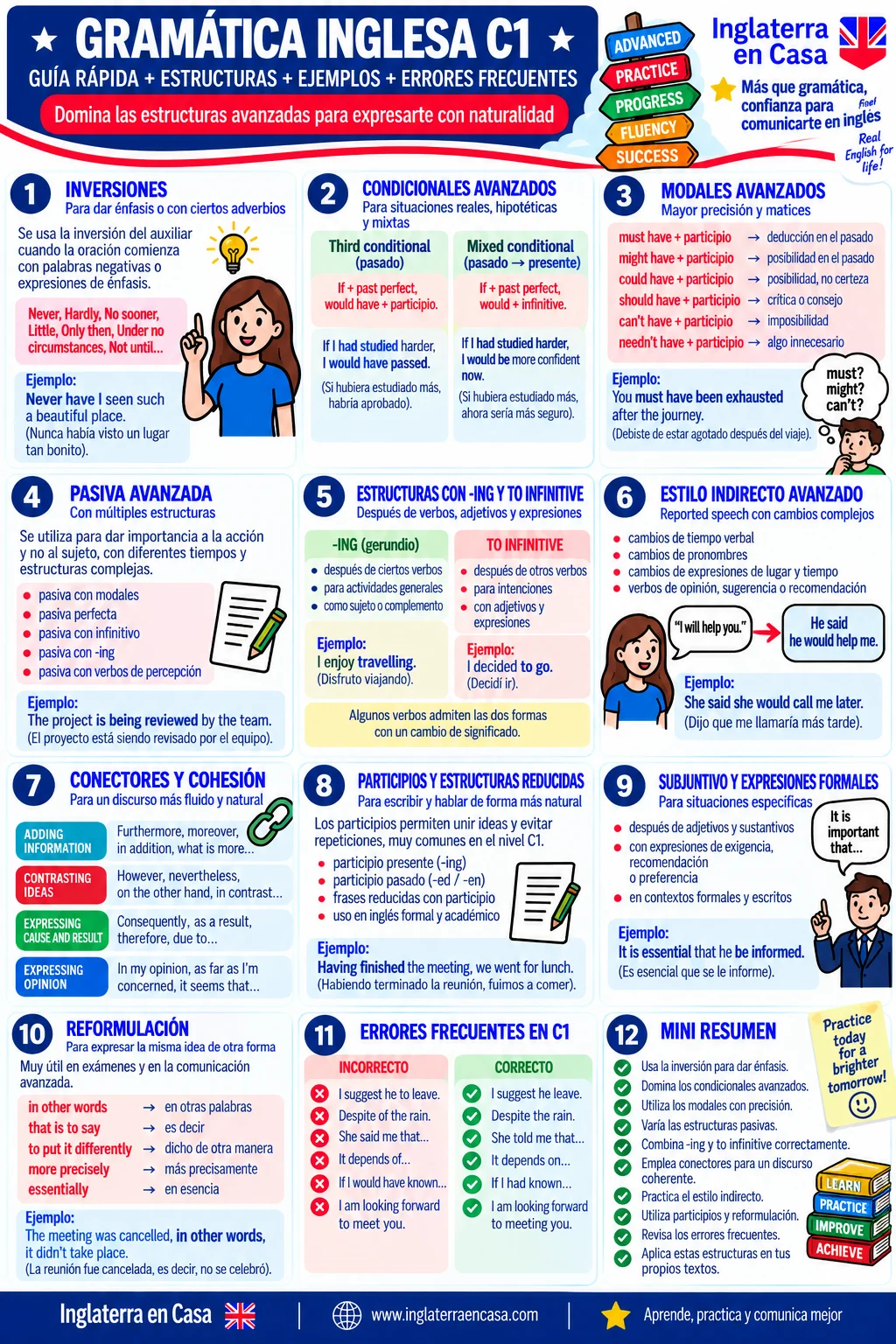
En el nivel C1 no basta con producir frases correctas: es necesario controlar matices, registro, énfasis y cohesión. Las actividades de esta guía trabajan precisión gramatical, flexibilidad sintáctica y reformulación, destrezas relevantes para un uso avanzado del inglés y para la preparación de exámenes como C1 Advanced.
Inversión y estructuras enfáticas
Tras expresiones negativas o restrictivas al inicio de una oración, se invierte el auxiliar y el sujeto: Never have I seen…, Only then did I realise…. Con Hardly y No sooner suele aparecer el pasado perfecto invertido: Hardly had we arrived when…; No sooner had we arrived than….
Condicionales avanzados y condicionales mixtos
Además de las condicionales habituales, C1 incluye inversiones sin if: Had I known, I would have acted; Were she to resign, we would need a replacement; Should you need assistance, contact us. En las condicionales mixtas se relaciona una condición pasada con una consecuencia presente: If I had accepted the offer, I would be living abroad now.
Deseos, preferencias y subjuntivo formal
I wish I had… expresa arrepentimiento pasado; I would rather you kept… formula una preferencia sobre otra persona; It is high time we left señala que una acción ya debería haberse realizado. En el registro formal, insist/suggest/essential that + sujeto + verbo base: They insisted that he be present.
Modales perfectos y deducción
Must have + participio indica deducción fuerte sobre el pasado; might/may have + participio, posibilidad; cannot have + participio, imposibilidad deducida; should have + participio, crítica o expectativa incumplida. El contexto determina la opción más adecuada.
Pasiva compleja y estructuras impersonales
He is believed to have left reformula People believe that he left. Si el hecho es anterior a la creencia, se usa to have + participio. La pasiva también aparece tras verbos y preposiciones: She objected to being excluded.
Gerundio, infinitivo y colocaciones
Tras preposiciones se emplea normalmente -ing: worth discussing, object to being excluded. Algunas construcciones cambian de sentido: remember doing recuerda una acción pasada; remember to do recuerda una obligación pendiente. También importan las combinaciones léxicas naturales: on the verge of, a thorough understanding.
Conectores y cohesión discursiva
El nivel C1 exige relacionar ideas con precisión. Although introduce una cláusula; despite/in spite of suelen preceder un sustantivo o una forma en -ing; nevertheless expresa contraste entre oraciones; provided that establece una condición; so that introduce finalidad con cláusula.
Estrategia para resolver ejercicios C1
Primero identifica la función: ¿énfasis, hipótesis, deducción, preferencia o contraste? Después comprueba el patrón gramatical, el tiempo verbal y la concordancia. En las transformaciones, conserva el significado original; en «Encuentra el error», corrige solo lo necesario. Revisa las soluciones al terminar cada bloque.
Ejemplos comparados: del B2 al C1
| Expresión habitual | Reformulación avanzada | Función |
|---|---|---|
| I had never seen it. | Never had I seen it. | Énfasis e inversión |
| If I had known… | Had I known… | Condicional invertida |
| People think she resigned. | She is thought to have resigned. | Pasiva impersonal |
| We should leave now. | It is high time we left. | Urgencia o crítica |
Errores frecuentes al estudiar inglés C1
Entre los errores más comunes están mantener el orden normal tras una expresión negativa inicial, usar would en la cláusula de if de una condicional de tercer tipo, confundir despite con although y olvidar el gerundio después de una preposición. Practicar estas diferencias ayuda a mejorar la precisión en la escritura y la expresión oral.
100 ejercicios de gramática C1 con soluciones
Los siguientes cinco bloques incluyen 20 actividades cada uno. Para una práctica con corrección visual inmediata, utiliza también el bloque interactivo de esta página. Las soluciones completas están después de las preguntas frecuentes.
Bloque 1. Completa las estructuras avanzadas (20 ejercicios)
- Hardly ___ the meeting begun when the fire alarm went off.
- Were the proposal ___ approved, funding would be released.
- It is high time the committee ___ a decision.
- She talks as though she ___ the entire report herself.
- No sooner ___ we sat down than the lights went out.
- The CEO insisted that the figures ___ independently verified.
- I would rather you ___ the matter confidential for now.
- Not until the audit was complete ___ they discover the discrepancy.
- The minister is believed ___ the country last night.
- By December, the team ___ on the project for eighteen months.
- If it ___ for her intervention, the deal would have collapsed.
- Under no circumstances ___ confidential files be shared.
- He denied ___ informed about the change.
- The report needs ___ before publication.
- Scarcely ___ she finished speaking when questions began.
- Supposing the supplier ___ to withdraw, what would we do?
- The evidence suggests that he ___ the warning.
- Only after reviewing the data ___ I understand the problem.
- She is accustomed to ___ under pressure.
- I wish I ___ more attention to the briefing yesterday.
Bloque 2. Elige la opción correcta (20 ejercicios)
- Little ___ how much the decision would cost. — A) they realised · B) did they realise · C) they had realised
- The document is thought ___ in the 17th century. — A) to have been written · B) to write · C) having written
- I would sooner you ___ this with the manager directly. — A) discuss · B) discussed · C) had discuss
- ___ the delay, we would have arrived on time. — A) But for · B) Despite of · C) Unless
- She was ___ to accept the revised terms. — A) reluctant · B) reluctantly · C) reluctance
- He ___ have known about the change; nobody told him. — A) cannot · B) must · C) should
- Not only ___ the deadline, but she also improved the design. — A) she met · B) did she meet · C) has she meet
- The issue is worth ___ in greater depth. — A) to discuss · B) discuss · C) discussing
- Had I known the risks, I ___ differently. — A) would act · B) would have acted · C) will act
- It was ___ a convincing argument that everyone agreed. — A) so · B) such · C) too
- The company is on the ___ of announcing a merger. — A) edge · B) verge · C) border
- She objected to ___ excluded from the discussion. — A) being · B) be · C) have
- I regret ___ you that your application was unsuccessful. — A) telling · B) to inform · C) informing
- ___ exhausted, he continued working. — A) Despite · B) Although · C) In spite
- The more carefully you plan, ___ mistakes you make. — A) the fewer · B) less · C) the least
- She has a ___ understanding of the subject. — A) thorough · B) through · C) thought
- It is essential that each candidate ___ identification. — A) brings · B) bring · C) brought
- I would rather ___ earlier yesterday. — A) leave · B) have left · C) to leave
- He spoke quietly ___ disturb the others. — A) so as not to · B) for not · C) in order not
- There is no point ___ about what cannot be changed. — A) to worry · B) worry · C) worrying
Bloque 3. Transformación de oraciones (20 ejercicios)
- I only understood the implications after I read the contract. (ONLY AFTER)
- The manager did not apologise at any point. (AT NO POINT)
- Without your help, we would have failed. (BUT FOR)
- People say the scientist falsified the results. (SAID)
- I regret not asking for clarification. (WISH)
- They started investigating in January and are still doing so. (BEEN)
- The board should reconsider the proposal. (HIGH TIME)
- The team had barely arrived when the presentation began. (HARDLY)
- She did not intend to offend anyone. (MEAN)
- The delay was caused by a shortage of materials. (RESULTED)
- I prefer you not to mention my name. (RATHER)
- The report was so complex that few understood it. (SUCH)
- He probably misunderstood the instructions. (MAY)
- You cannot enter unless you have a pass. (PROVIDED)
- They believe the painting was stolen in 1998. (BELIEVED)
- She succeeded despite lacking experience. (ALTHOUGH)
- We must not disclose this information. (CIRCUMSTANCES)
- I last spoke to him three months ago. (FOR)
- He is likely to resign soon. (VERGE)
- They postponed the launch because of technical issues. (DUE)
Bloque 4. Encuentra el error (20 ejercicios)
- Never I have encountered such resistance.
- If I would have known, I would have objected.
- She suggested to postpone the meeting.
- It is high time we take action.
- He is believed that he left yesterday.
- Hardly we had arrived when it started raining.
- Despite of the evidence, he denied everything.
- I wish I would have studied harder.
- The more you practise, the more fluent you become it.
- She insisted that he apologises immediately.
- He objected to be excluded from the vote.
- No sooner we arrived than the speech began.
- This proposal is worth to consider.
- I would rather you do not tell anyone.
- Only then I realised my mistake.
- He must have forgot the appointment.
- She denied to have leaked the document.
- The results are expected announcing tomorrow.
- Not only she was late, but she also forgot the files.
- Unless you do not revise, you will struggle.
Bloque 5. Conectores y cohesión C1 (20 ejercicios)
- ___ the research was thorough, the sample was too small.
- The figures were revised; ___, the overall conclusion remained unchanged.
- The trial was cancelled ___ insufficient funding.
- ___ the evidence presented, the committee approved the proposal.
- The changes were introduced ___ improve accessibility.
- The data were anonymised ___ participants could not be identified.
- The plan will proceed ___ the safety review is satisfactory.
- The findings were inconsistent; ___, further testing was recommended.
- The team continued working ___ severe time constraints.
- ___ the supplier withdraws, we have an alternative.
- The report is detailed, ___ its conclusions remain tentative.
- ___ the costs rise, the project may be postponed.
- The proposal was rejected ___ its apparent benefits.
- The policy was revised ___ feedback from staff.
- ___ the new system is more efficient, it requires training.
- The figures were checked twice ___ avoid errors.
- The scheme will be extended ___ demand remains high.
- ___ the outcome, the participants will receive feedback.
- The deadline was extended; ___, several teams still missed it.
- ___ the initial setback, the research ultimately succeeded.
Ejercicios interactivos
Ejercicios interactivos de gramática inglesa C1
60 preguntas autocorregibles con CSS, sin JavaScript. Selecciona una respuesta: el color verde indica acierto y el rojo señala que debes intentarlo de nuevo. Puedes cambiar tu elección.
Tipo 1: opción múltiple (20 preguntas)
1. Little ___ how much the decision would cost.
Ver explicación
Inversión después de Little al inicio.
2. The document is thought ___ in the 17th century.
Ver explicación
Pasiva con infinitivo perfecto.
3. I would sooner you ___ this with the manager directly.
Ver explicación
Would sooner + sujeto + pasado para preferencia presente.
4. ___ the delay, we would have arrived on time.
Ver explicación
But for significa «de no haber sido por».
5. She was ___ to accept the revised terms.
Ver explicación
Se necesita un adjetivo tras was.
6. He ___ have known about the change; nobody told him.
Ver explicación
Deducción negativa sobre el pasado: cannot have known.
7. Not only ___ the deadline, but she also improved the design.
Ver explicación
Inversión con Not only al inicio.
8. The issue is worth ___ in greater depth.
Ver explicación
Worth + -ing.
9. Had I known the risks, I ___ differently.
Ver explicación
Condicional invertida de tercer tipo.
10. It was ___ a convincing argument that everyone agreed.
Ver explicación
Such + artículo + adjetivo + sustantivo.
11. The company is on the ___ of announcing a merger.
Ver explicación
Colocación: on the verge of.
12. She objected to ___ excluded from the discussion.
Ver explicación
Object to + -ing; pasiva: being excluded.
13. I regret ___ you that your application was unsuccessful.
Ver explicación
Regret to inform introduce malas noticias.
14. ___ exhausted, he continued working.
Ver explicación
Although + cláusula con verbo.
15. The more carefully you plan, ___ mistakes you make.
Ver explicación
Comparativa correlativa: the more..., the fewer...
16. She has a ___ understanding of the subject.
Ver explicación
Thorough = exhaustivo.
17. It is essential that each candidate ___ identification.
Ver explicación
Subjuntivo formal: base verbal.
18. I would rather ___ earlier yesterday.
Ver explicación
Preferencia retrospectiva: would rather have + participio.
19. He spoke quietly ___ disturb the others.
Ver explicación
So as not to + infinitivo; «in order not» requiere to.
20. There is no point ___ about what cannot be changed.
Ver explicación
There is no point + -ing.
Tipo 2: completa la frase (20 preguntas)
1. Hardly ___ the meeting begun when the fire alarm went off.
Ver explicación
La respuesta esperada es: had.
2. Were the proposal ___ approved, funding would be released.
Ver explicación
La respuesta esperada es: to be.
3. It is high time the committee ___ a decision.
Ver explicación
La respuesta esperada es: made.
4. She talks as though she ___ the entire report herself.
Ver explicación
La respuesta esperada es: had written.
5. No sooner ___ we sat down than the lights went out.
Ver explicación
La respuesta esperada es: had.
6. The CEO insisted that the figures ___ independently verified.
Ver explicación
La respuesta esperada es: be.
7. I would rather you ___ the matter confidential for now.
Ver explicación
La respuesta esperada es: kept.
8. Not until the audit was complete ___ they discover the discrepancy.
Ver explicación
La respuesta esperada es: did.
9. The minister is believed ___ the country last night.
Ver explicación
La respuesta esperada es: to have left.
10. By December, the team ___ on the project for eighteen months.
Ver explicación
La respuesta esperada es: will have been working.
11. If it ___ for her intervention, the deal would have collapsed.
Ver explicación
La respuesta esperada es: had not been.
12. Under no circumstances ___ confidential files be shared.
Ver explicación
La respuesta esperada es: should.
13. He denied ___ informed about the change.
Ver explicación
La respuesta esperada es: having been.
14. The report needs ___ before publication.
Ver explicación
La respuesta esperada es: revising / to be revised.
15. Scarcely ___ she finished speaking when questions began.
Ver explicación
La respuesta esperada es: had.
16. Supposing the supplier ___ to withdraw, what would we do?
Ver explicación
La respuesta esperada es: were.
17. The evidence suggests that he ___ the warning.
Ver explicación
La respuesta esperada es: may have ignored / might have ignored.
18. Only after reviewing the data ___ I understand the problem.
Ver explicación
La respuesta esperada es: did.
19. She is accustomed to ___ under pressure.
Ver explicación
La respuesta esperada es: working.
20. I wish I ___ more attention to the briefing yesterday.
Ver explicación
La respuesta esperada es: had paid.
Tipo 3: conectores y cohesión (20 preguntas)
1. ___ the research was thorough, the sample was too small.
Ver explicación
Conector adecuado: Although. Comprueba la relación lógica y la estructura que sigue.
2. The figures were revised; ___, the overall conclusion remained unchanged.
Ver explicación
Conector adecuado: nevertheless. Comprueba la relación lógica y la estructura que sigue.
3. The trial was cancelled ___ insufficient funding.
Ver explicación
Conector adecuado: due to. Comprueba la relación lógica y la estructura que sigue.
4. ___ the evidence presented, the committee approved the proposal.
Ver explicación
Conector adecuado: Despite. Comprueba la relación lógica y la estructura que sigue.
5. The changes were introduced ___ improve accessibility.
Ver explicación
Conector adecuado: in order to. Comprueba la relación lógica y la estructura que sigue.
6. The data were anonymised ___ participants could not be identified.
Ver explicación
Conector adecuado: so that. Comprueba la relación lógica y la estructura que sigue.
7. The plan will proceed ___ the safety review is satisfactory.
Ver explicación
Conector adecuado: provided that. Comprueba la relación lógica y la estructura que sigue.
8. The findings were inconsistent; ___, further testing was recommended.
Ver explicación
Conector adecuado: therefore. Comprueba la relación lógica y la estructura que sigue.
9. The team continued working ___ severe time constraints.
Ver explicación
Conector adecuado: in spite of. Comprueba la relación lógica y la estructura que sigue.
10. ___ the supplier withdraws, we have an alternative.
Ver explicación
Conector adecuado: In case. Comprueba la relación lógica y la estructura que sigue.
11. The report is detailed, ___ its conclusions remain tentative.
Ver explicación
Conector adecuado: yet. Comprueba la relación lógica y la estructura que sigue.
12. ___ the costs rise, the project may be postponed.
Ver explicación
Conector adecuado: Should. Comprueba la relación lógica y la estructura que sigue.
13. The proposal was rejected ___ its apparent benefits.
Ver explicación
Conector adecuado: despite. Comprueba la relación lógica y la estructura que sigue.
14. The policy was revised ___ feedback from staff.
Ver explicación
Conector adecuado: in response to. Comprueba la relación lógica y la estructura que sigue.
15. ___ the new system is more efficient, it requires training.
Ver explicación
Conector adecuado: While. Comprueba la relación lógica y la estructura que sigue.
16. The figures were checked twice ___ avoid errors.
Ver explicación
Conector adecuado: so as to. Comprueba la relación lógica y la estructura que sigue.
17. The scheme will be extended ___ demand remains high.
Ver explicación
Conector adecuado: as long as. Comprueba la relación lógica y la estructura que sigue.
18. ___ the outcome, the participants will receive feedback.
Ver explicación
Conector adecuado: Regardless of. Comprueba la relación lógica y la estructura que sigue.
19. The deadline was extended; ___, several teams still missed it.
Ver explicación
Conector adecuado: even so. Comprueba la relación lógica y la estructura que sigue.
20. ___ the initial setback, the research ultimately succeeded.
Ver explicación
Conector adecuado: Notwithstanding. Comprueba la relación lógica y la estructura que sigue.
Consejo: para transformar oraciones y corregir errores abiertos, utiliza los otros 40 ejercicios del artículo o el PDF. La corrección automática de respuestas escritas no puede hacerse de forma fiable solo con CSS.
Preguntas frecuentes sobre los ejercicios de inglés C1
¿Qué temas de gramática se trabajan en C1?
Inversión, condicionales avanzados, modales perfectos, pasiva compleja, gerundios e infinitivos, subjuntivo formal, reformulación y conectores discursivos.
¿Cuántos ejercicios incluye esta guía C1?
Incluye 100 ejercicios repartidos en cinco bloques de 20 actividades, además de sus soluciones.
¿Puedo practicar gramática C1 online sin registrarme?
Sí. Puedes utilizar los ejercicios de esta página y consultar las respuestas sin crear una cuenta.
¿Los ejercicios son útiles para Cambridge C1 Advanced?
Sirven para reforzar estructuras y habilidades lingüísticas propias del nivel C1, aunque no sustituyen los modelos oficiales ni reproducen exactamente todos sus formatos.
¿Qué diferencia hay entre B2 y C1?
En C1 se exige mayor flexibilidad, precisión, dominio del registro y capacidad para reformular ideas complejas.
¿Puedo descargar los ejercicios C1 en PDF con soluciones?
Sí. El material descargable incluye un resumen teórico, actividades y soluciones al final.
¿Cómo puedo saber si una inversión es necesaria?
Comprueba si la oración comienza con expresiones como Never, Hardly, No sooner, Little u Only then, que suelen exigir inversión del auxiliar.
¿Qué hago si todavía cometo muchos errores de C1?
Revisa primero la regla correspondiente, repite los ejercicios y refuerza las bases con los materiales de B1 y B2 si lo necesitas.
Soluciones de los 100 ejercicios de gramática C1
Comprueba las respuestas solo después de intentar cada bloque. En algunas frases abiertas pueden existir otras alternativas correctas si mantienen la estructura y el significado.
Soluciones del bloque 1: Completa las estructuras avanzadas
- had
- to be
- made
- had written
- had
- be
- kept
- did
- to have left
- will have been working
- had not been
- should
- having been
- revising / to be revised
- had
- were
- may have ignored / might have ignored
- did
- working
- had paid
Soluciones del bloque 2: Elige la opción correcta
- B — did they realise (Inversión después de Little al inicio.)
- A — to have been written (Pasiva con infinitivo perfecto.)
- B — discussed (Would sooner + sujeto + pasado para preferencia presente.)
- A — But for (But for significa «de no haber sido por».)
- A — reluctant (Se necesita un adjetivo tras was.)
- A — cannot (Deducción negativa sobre el pasado: cannot have known.)
- B — did she meet (Inversión con Not only al inicio.)
- C — discussing (Worth + -ing.)
- B — would have acted (Condicional invertida de tercer tipo.)
- B — such (Such + artículo + adjetivo + sustantivo.)
- B — verge (Colocación: on the verge of.)
- A — being (Object to + -ing; pasiva: being excluded.)
- B — to inform (Regret to inform introduce malas noticias.)
- B — Although (Although + cláusula con verbo.)
- A — the fewer (Comparativa correlativa: the more…, the fewer…)
- A — thorough (Thorough = exhaustivo.)
- B — bring (Subjuntivo formal: base verbal.)
- B — have left (Preferencia retrospectiva: would rather have + participio.)
- A — so as not to (So as not to + infinitivo; «in order not» requiere to.)
- C — worrying (There is no point + -ing.)
Soluciones del bloque 3: Transformación de oraciones
- Only after I read the contract did I understand the implications.
- At no point did the manager apologise.
- But for your help, we would have failed.
- The scientist is said to have falsified the results.
- I wish I had asked for clarification.
- They have been investigating since January.
- It is high time the board reconsidered the proposal.
- Hardly had the team arrived when the presentation began.
- She did not mean to offend anyone.
- The shortage of materials resulted in the delay.
- I would rather you did not mention my name.
- It was such a complex report that few understood it.
- He may have misunderstood the instructions.
- You can enter provided that you have a pass.
- The painting is believed to have been stolen in 1998.
- Although she lacked experience, she succeeded.
- Under no circumstances must we disclose this information.
- I have not spoken to him for three months.
- He is on the verge of resigning.
- The launch was postponed due to technical issues.
Soluciones del bloque 4: Encuentra el error
- Never have I encountered such resistance.
- If I had known, I would have objected.
- She suggested postponing the meeting.
- It is high time we took action.
- He is believed to have left yesterday.
- Hardly had we arrived when it started raining.
- Despite the evidence, he denied everything.
- I wish I had studied harder.
- The more you practise, the more fluent you become.
- She insisted that he apologise immediately.
- He objected to being excluded from the vote.
- No sooner had we arrived than the speech began.
- This proposal is worth considering.
- I would rather you did not tell anyone.
- Only then did I realise my mistake.
- He must have forgotten the appointment.
- She denied having leaked the document.
- The results are expected to be announced tomorrow.
- Not only was she late, but she also forgot the files.
- Unless you revise, you will struggle.
Soluciones del bloque 5: Conectores y cohesión C1
- Although
- nevertheless
- due to
- Despite
- in order to
- so that
- provided that
- therefore
- in spite of
- In case
- yet
- Should
- despite
- in response to
- While
- so as to
- as long as
- Regardless of
- even so
- Notwithstanding