
Ejercicios gramática inglés B1 online en PDF y con soluciones
Los ejercicios de gramática en inglés B1 online son una forma práctica de consolidar las estructuras que un estudiante intermedio necesita usar con más seguridad. En este nivel ya no basta con reconocer una regla aislada: hay que elegir el tiempo verbal adecuado, expresar obligación o posibilidad, relacionar ideas, transformar frases y detectar errores habituales sin perder de vista el significado.
Esta guía reúne teoría clara, ejemplos y práctica variada. Puedes trabajar primero el repaso gramatical, continuar con los ejercicios escritos, utilizar el bloque interactivo y, después, descargar el PDF con las soluciones para revisar el trabajo. El objetivo es que estos ejercicios de gramática de nivel B1 sirvan tanto para estudio autónomo como para complementar clases presenciales.
Qué se trabaja en estos ejercicios de gramática en inglés B1 online
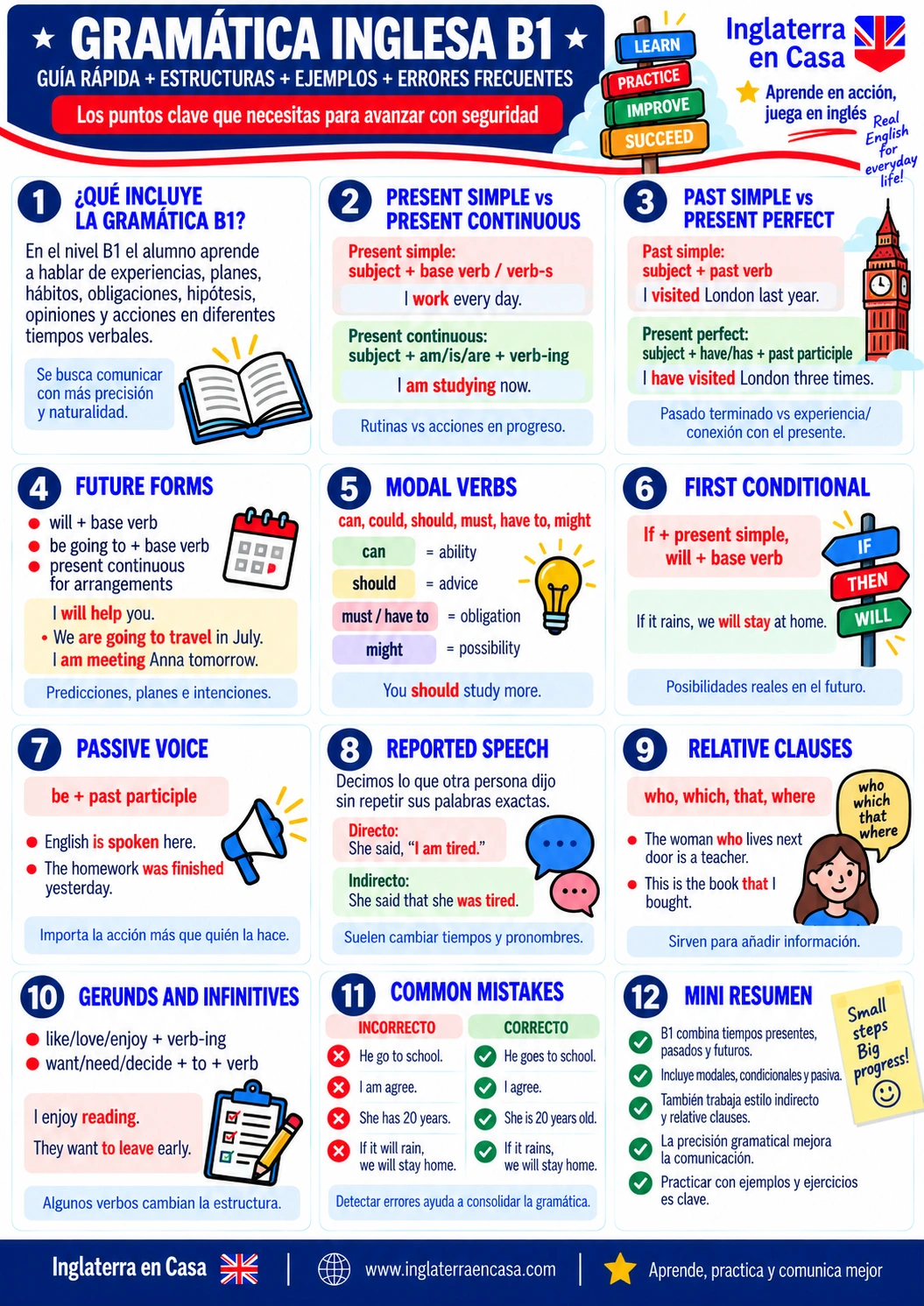
El nivel B1 exige combinar varias áreas de la gramática en contextos cotidianos. Por eso, la práctica no se limita a una lista de tiempos verbales. En los siguientes apartados se revisan las estructuras más útiles para hablar de experiencias, narrar hechos pasados, organizar planes, hacer predicciones, expresar hipótesis, dar consejos, describir procesos y transmitir lo que otra persona ha dicho.
Tiempos de presente: present simple y present continuous
El present simple se usa para rutinas, hábitos, hechos estables y verdades generales: I work in Valencia. El present continuous presenta acciones en progreso o situaciones temporales: I am working from home this week. También puede utilizarse para planes futuros ya organizados: We are meeting Sara on Friday. Un error frecuente en B1 es emplear el continuous con verbos de estado como know, need, believe o understand cuando se habla de su significado habitual.
Past simple y past continuous para narrar
El past simple cuenta acciones terminadas: We visited Oxford last year. El past continuous sitúa una acción en desarrollo en un momento pasado o crea el fondo de una narración: I was walking home when it started to rain. En una historia es frecuente combinar ambos: la acción larga aparece en past continuous y el hecho que la interrumpe, en past simple.
Present perfect y su diferencia con past simple
El present perfect se forma con have/has + past participle. Se usa para experiencias, resultados presentes y situaciones que empezaron en el pasado y continúan ahora: I have lived here for three years. Cuando mencionamos un momento pasado terminado, normalmente usamos past simple: I moved here in 2023. Palabras como ever, never, already, yet, just, for y since aparecen con frecuencia en la práctica de B1.
Formas de futuro: will, be going to y present continuous
Will es habitual para decisiones tomadas en el momento, predicciones y promesas: I’ll help you. Be going to expresa planes o predicciones basadas en evidencias: Look at those clouds. It’s going to rain. El present continuous se utiliza para planes personales ya acordados: I’m seeing the dentist tomorrow. Los ejercicios de gramática en inglés B1 online deben obligar a interpretar la situación antes de elegir una forma.
Zero, first y second conditional
El zero conditional expresa hechos generales: If you heat ice, it melts. El first conditional habla de una posibilidad real futura: If it rains, we’ll stay home. El second conditional presenta situaciones hipotéticas o poco probables: If I had more time, I would travel more. Después de if no se usa normalmente will en el first conditional.
Verbos modales: obligación, consejo, posibilidad y deducción
En B1 conviene distinguir must, have to, should, can, could, may y might. You must wear a seat belt expresa obligación; You don’t have to come early indica ausencia de necesidad; You mustn’t park here expresa prohibición; y You should rest funciona como consejo. May y might permiten hablar de posibilidad.
Voz pasiva
La pasiva se construye con una forma de be + past participle. Se utiliza cuando interesa más la acción o el resultado que la persona que realiza la acción: English is spoken in many countries; The bridge was built in 2010. El tiempo verbal se refleja en el verbo be, mientras que el participio permanece estable.
Reported speech o estilo indirecto
El estilo indirecto permite contar lo que alguien dijo: “I am tired” → She said that she was tired. En B1 es importante reconocer cambios frecuentes de tiempo verbal, pronombres y referencias temporales. También conviene distinguir say de tell: say something, pero tell someone something.
Oraciones de relativo
Las oraciones de relativo añaden información sobre personas, cosas y lugares. Who se usa normalmente para personas, which para cosas, that puede sustituir a ambos en muchas relativas definitorias y where se refiere a lugares: The woman who called me is my teacher; This is the café where we met.
Used to, be used to y get used to
Used to + verbo base describe hábitos o situaciones pasadas que ya no son ciertas: I used to play tennis every weekend. Be used to + nombre o -ing significa estar acostumbrado: I’m used to getting up early. Get used to describe el proceso de acostumbrarse.
Gerundio, infinitivo, comparativos y cuantificadores
Muchos verbos van seguidos de -ing (enjoy reading) y otros de to + infinitive (decide to leave). También es esencial controlar comparativos y superlativos (easier, more interesting, the best) y cuantificadores como much, many, a little, a few, too much y too many. La selección depende de si el nombre es contable o incontable.
Cómo aprovechar la práctica de gramática B1
Una estrategia útil es realizar primero cada bloque sin consultar las soluciones. Después conviene revisar solo las respuestas dudosas, identificar la regla que explica el error y crear una frase propia con esa estructura. Al volver a estos ejercicios de gramática en inglés B1 online unos días más tarde, el alumno puede comprobar si la corrección se ha convertido en aprendizaje estable.
No es necesario intentar memorizar todas las reglas a la vez. El nivel B1 se consolida mejor cuando la gramática aparece ligada a situaciones reales: hablar de planes, contar una experiencia, dar un consejo, describir un lugar o explicar lo que otra persona dijo. La práctica variada ayuda a pasar de reconocer la forma correcta a utilizarla con naturalidad.
Ejercicios de gramática en inglés B1 online: práctica completa
Los siguientes bloques mezclan las áreas principales del nivel. Hay ejercicios de tiempos verbales, transformación de frases, elección múltiple y corrección de errores. Las soluciones aparecen después de las preguntas frecuentes para que puedas trabajar primero sin ver las respuestas.
Bloque 1: completa con la forma verbal correcta
- I usually ___ (go) to the gym after work.
- Look! The children ___ (play) in the garden.
- We ___ (visit) Edinburgh last summer.
- While I ___ (walk) home, it started to rain.
- She ___ never ___ (try) sushi before.
- I ___ (know) Marta since 2022.
- They ___ already ___ (finish) the project.
- He ___ (not see) that film yet.
- At 8 p.m. yesterday, we ___ (have) dinner.
- My brother ___ (work) in London for three years, and he still works there.
- I think it ___ (rain) tomorrow.
- We ___ (meet) Laura at 6 p.m. on Friday; it’s already arranged.
- Look at those clouds! It ___ (rain).
- If you ___ (study) regularly, you will improve.
- If I ___ (have) more free time, I would learn Italian.
- You ___ (not have to) bring food; everything is provided.
- You ___ (should) see a doctor if the pain continues.
- This book ___ (write) in 1998.
- The emails ___ (send) every Monday morning.
- She said that she ___ (be) tired.
Bloque 2: reescribe la frase sin cambiar el significado
- People speak English in many countries.
- They built this bridge in 2010.
- Someone has stolen my bike.
- ‘I am busy,’ Tom said.
- ‘We will call you tomorrow,’ they said.
- ‘I can’t swim,’ Ana said.
- This is the café. We met here last year.
- The woman is my teacher. She is wearing a red coat.
- The book is very interesting. You lent it to me.
- I played tennis every Saturday when I was younger.
- It isn’t necessary for you to come early.
- It is a good idea to practise every day.
- Perhaps James is at home.
- If you don’t hurry, you will miss the bus.
- I don’t have enough money, so I can’t buy the laptop.
- The last time I saw Paula was in May.
- I started studying English two years ago and I still study it.
- The blue car is cheaper than the red car.
- No other student in the class is as tall as Leo.
- Despite the rain, we went for a walk.
Bloque 3: elige la opción correcta
- I haven’t finished my homework ___. (already / yet / since)
- We’ve lived here ___ five years. (since / for / ago)
- She has worked here ___ 2021. (for / since / during)
- There isn’t ___ milk left. (many / much / a few)
- We have ___ friends in Manchester. (a little / a few / much)
- This exercise is ___ than the previous one. (easy / easier / easiest)
- It’s the ___ film I’ve seen this year. (funniest / funnier / funny)
- You ___ smoke here. It’s forbidden. (mustn’t / don’t have to / might not)
- You ___ wear a uniform; it’s optional. (mustn’t / don’t have to / shouldn’t)
- He ___ be at work; his car isn’t there. (can’t / must / should)
- If it rains tomorrow, we ___ at home. (stay / will stay / would stay)
- If I were you, I ___ to the manager. (will speak / would speak / speak)
- The person ___ called you is my cousin. (which / who / where)
- That’s the restaurant ___ we had dinner. (who / where / whose)
- My phone ___ in China. (makes / is made / made)
- She said she ___ tired. (is / was / has)
- I enjoy ___ new languages. (learn / learning / to learned)
- We decided ___ by train. (travel / travelling / to travel)
- I ___ getting up early now; it doesn’t bother me. (used to / am used to / use to)
- He’s coming, ___ he? (isn’t / doesn’t / hasn’t)
Bloque 4: encuentra el error
Todas las frases de este bloque contienen un error gramatical. Localízalo y escribe la frase correctamente.
- I have seen her yesterday.
- She don’t like coffee.
- We are living here since 2020.
- He has went to the supermarket.
- If I will see Marta, I’ll tell her.
- If I would have more time, I’d travel more.
- You must to wear a seat belt.
- You don’t must pay now.
- The room cleans every day.
- This picture was paint by my grandfather.
- She said me that she was tired.
- He asked me where was I going.
- That’s the man which helped me.
- The hotel where we stayed in was expensive.
- I used to playing football every weekend.
- I’m used to get up early.
- This test is more easier than the last one.
- There are too much people here.
- I look forward to see you.
- She suggested to go by bus.
Ejercicios interactivos
Ejercicios interactivos de gramática B1
Selecciona una opción en cada pregunta. El bloque funciona únicamente con HTML y CSS: no utiliza JavaScript.
1. Tiempos verbales
2. Modales y significado
3. Transformaciones B1
4. Condicionales y conectores
5. Precisión y errores frecuentes
Preguntas frecuentes sobre ejercicios de gramática B1
¿Qué gramática debe dominar un alumno de nivel B1?
En B1 conviene manejar con seguridad los tiempos presentes y pasados más habituales, present perfect, formas de futuro, condicionales básicos, verbos modales, voz pasiva, estilo indirecto, oraciones de relativo, comparativos, cuantificadores y patrones frecuentes con infinitivo y gerundio.
¿Estos ejercicios de gramática en inglés B1 online sirven para preparar Cambridge B1 Preliminary?
Sí, ayudan a reforzar estructuras propias del nivel B1 y a ganar precisión. Para preparar un examen oficial también es importante practicar lectura, escritura, comprensión auditiva y expresión oral con el formato específico de la prueba.
¿Cuánto tiempo debería dedicar a practicar gramática B1?
Es más eficaz trabajar de forma regular que concentrarlo todo en una sola sesión. Unos 15 o 25 minutos varias veces por semana permiten revisar una estructura, practicarla y volver a ella después para consolidarla.
¿Qué diferencia hay entre past simple y present perfect?
El past simple presenta acciones terminadas en un momento pasado cerrado, mientras que el present perfect conecta una experiencia, estado o resultado pasado con el presente y suele aparecer con expresiones como ever, never, already, yet, for o since.
¿Qué condicionales se trabajan en B1?
El zero conditional, el first conditional y el second conditional son especialmente útiles en B1. Permiten expresar hechos generales, posibilidades reales futuras y situaciones hipotéticas o poco probables.
¿Cómo puedo saber si debo usar must, have to o should?
Must y have to expresan obligación, aunque su matiz y origen pueden variar. Should se utiliza normalmente para consejo o recomendación. También es importante distinguir mustn't, que indica prohibición, de don't have to, que significa que algo no es necesario.
¿Por qué es útil corregir errores además de completar ejercicios?
Detectar y corregir errores obliga a fijarse en la forma y en el significado al mismo tiempo. Ese proceso ayuda a reconocer fallos frecuentes y facilita que el alumno evite repetirlos al escribir o hablar.
¿Es mejor practicar la gramática B1 online o en PDF?
Los dos formatos se complementan. La práctica online permite comprobar opciones de forma inmediata, mientras que el PDF resulta útil para estudiar sin conexión, escribir a mano y repetir los ejercicios con calma.
Soluciones de los ejercicios
Soluciones del bloque 1
- go
- are playing
- visited
- was walking
- has never tried
- have known
- have already finished
- hasn't seen
- were having
- has worked
- will rain
- are meeting
- is going to rain
- study
- had
- don't have to
- should
- was written
- are sent
- was
Soluciones del bloque 2
- English is spoken in many countries.
- This bridge was built in 2010.
- My bike has been stolen.
- Tom said that he was busy.
- They said that they would call me the next day.
- Ana said that she couldn't swim.
- This is the café where we met last year.
- The woman who is wearing a red coat is my teacher.
- The book that you lent me is very interesting.
- I used to play tennis every Saturday when I was younger.
- You don't have to come early.
- You should practise every day.
- James might be at home.
- Unless you hurry, you will miss the bus.
- If I had enough money, I could buy the laptop.
- I haven't seen Paula since May.
- I have studied English for two years.
- The red car is more expensive than the blue car.
- Leo is the tallest student in the class.
- Although it was raining, we went for a walk.
Soluciones del bloque 3
- yet
- for
- since
- much
- a few
- easier
- funniest
- mustn't
- don't have to
- can't
- will stay
- would speak
- who
- where
- is made
- was
- learning
- to travel
- am used to
- isn't
Soluciones del bloque 4: encuentra el error
- I saw her yesterday.
- She doesn't like coffee.
- We have lived here since 2020.
- He has gone to the supermarket.
- If I see Marta, I'll tell her.
- If I had more time, I'd travel more.
- You must wear a seat belt.
- You don't have to pay now.
- The room is cleaned every day.
- This picture was painted by my grandfather.
- She told me that she was tired.
- He asked me where I was going.
- That's the man who helped me.
- The hotel where we stayed was expensive.
- I used to play football every weekend.
- I'm used to getting up early.
- This test is easier than the last one.
- There are too many people here.
- I look forward to seeing you.
- She suggested going by bus.