

Ejercicios de gramática en inglés C2 online, en PDF y con soluciones
Los ejercicios de gramática inglesa C2 online permiten entrenar algo más que la corrección formal: la elección de estructuras según el contexto, la precisión de los matices y la capacidad de reformular con naturalidad. Esta guía reúne explicaciones claras, 120 actividades y soluciones orientativas para estudiantes de nivel avanzado.
Si estás preparando Cambridge C2 Proficiency o quieres perfeccionar tu inglés académico y profesional, trabaja cada bloque antes de consultar las respuestas. También puedes descargar un PDF complementario con 120 ejercicios distintos de los de esta página.
Aprende inglés con Inglaterra en Casa
En Inglaterra en Casa ofrecemos formación presencial de inglés en Marxalenes y Mislata, con actividades participativas, preparación de exámenes Cambridge y propuestas de inmersión para diferentes edades. Nuestro equipo docente nativo ayuda a trasladar la gramática a situaciones reales de comunicación.
Si quieres repasar las estructuras previas, visita nuestros ejercicios de gramática inglesa B1 y los ejercicios de gramática inglesa B2. Si ya dominas ambos, repasa también la práctica de C1 antes de avanzar a las estructuras de mayor exigencia.
Índice de contenidos
- Qué se exige en gramática inglesa C1
- Inversión y estructuras enfáticas
- Condicionales avanzados y condicionales mixtos
- Deseos, preferencias y subjuntivo formal
- Modales perfectos y deducción
- Pasiva compleja y estructuras impersonales
- Gerundio, infinitivo y colocaciones
- Conectores y cohesión discursiva
- Estrategia para resolver ejercicios C1
- Ejercicios C1 con soluciones
- Preguntas frecuentes
Marco teórico: gramática avanzada para el nivel C2
Inversión y adverbiales restrictivos
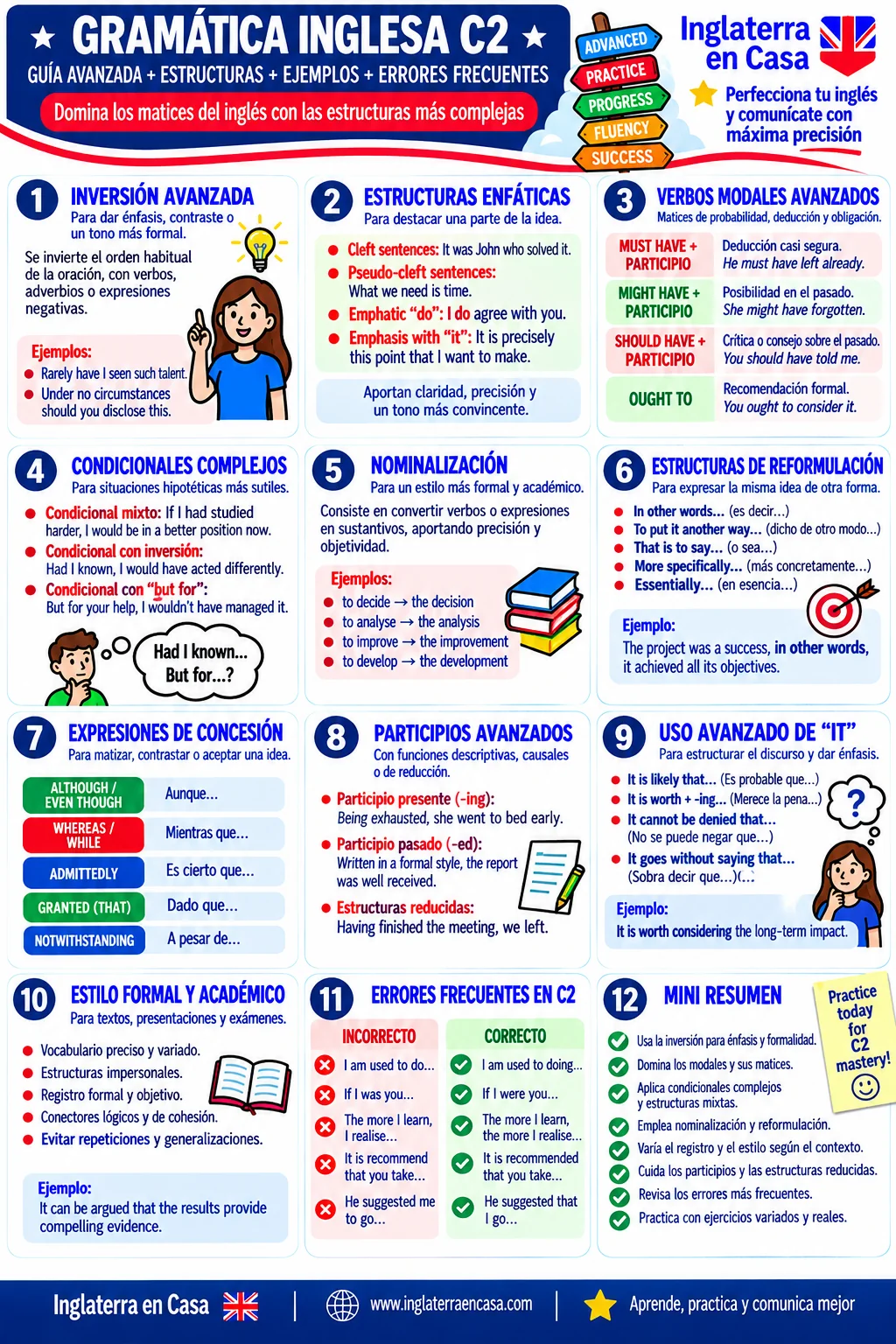
Con expresiones iniciales como Hardly, Barely, Not until, Under no circumstances, Only after se invierte el auxiliar y el sujeto. Not until the data arrived did we proceed. No se invierte toda oración que contenga una negación; importa su posición y función.
Énfasis con cleft sentences
Las it-clefts y what-clefts focalizan una parte del mensaje: It was the timing that caused the problem; What mattered was the timing. La transformación debe conservar el significado y evitar cambios de agente.
Modales perfectos y matices
Must have + participle expresa una deducción fuerte; might have una posibilidad; should have una crítica o expectativa incumplida; needn’t have una acción realizada que resultó innecesaria. No son intercambiables.
Condicionales irreales y mixtos
El tercer condicional combina if + past perfect con would have + participle. El condicional mixto puede vincular una causa pasada con un resultado actual: If she had applied, she would be working here now. Las formas deben reflejar la cronología.
Nominalización y estilo formal
La nominalización transforma procesos en entidades: They decided to postpone the launch → The decision to postpone the launch. Mejora la densidad informativa, pero el abuso puede dificultar la lectura. En C2 también importa la claridad.
Concesión, coherencia y alcance
Much as introduce una concesión; even if plantea una condición hipotética que no modifica la conclusión; despite exige sintagma nominal o gerundio. Elegir conectores depende de la relación lógica, no solo del vocabulario.
Qué diferencia el C2 del C1
C2 no consiste únicamente en memorizar estructuras raras: exige precisión, naturalidad, control del registro, énfasis adecuado y reformulación sin pérdida de significado. Algunas soluciones abiertas admiten variantes igualmente válidas.
Cómo preparar Cambridge C2 Proficiency
La práctica gramatical favorece especialmente el control lingüístico de Reading and Use of English, pero no reemplaza tareas auténticas de lectura, escritura, comprensión auditiva y expresión oral. Conviene contrastar el formato del examen con los materiales oficiales.
Cómo aprovechar estos ejercicios de gramática inglesa C2 online
Intenta resolver cada actividad sin mirar la solución, comprueba el alcance del significado y anota por qué has elegido esa estructura. En las transformaciones, una respuesta puede ser gramatical pero no conservar exactamente la intención original. Los ejercicios de la web y del PDF son diferentes para que puedas comprobar tu progreso sin repetir respuestas memorizadas.
120 ejercicios de gramática inglesa C2 con soluciones
Bloque 1: Inversión y énfasis adverbial (20 ejercicios)
Reescribe cada oración según la indicación. Conserva el significado original y el registro.
- The committee had barely begun to approve the revised budget when the session ended. Rewrite beginning with «Barely».
- The researchers had barely begun to publish their findings when the session ended. Rewrite beginning with «Barely».
- The director had barely begun to reconsider the proposal when the session ended. Rewrite beginning with «Barely».
- The witnesses had barely begun to change their statements when the session ended. Rewrite beginning with «Barely».
- The agency had barely begun to disclose the figures when the session ended. Rewrite beginning with «Barely».
- The editor had barely begun to correct the article when the session ended. Rewrite beginning with «Barely».
- The council had barely begun to reverse its decision when the session ended. Rewrite beginning with «Barely».
- The engineers had barely begun to identify the fault when the session ended. Rewrite beginning with «Barely».
- The auditors had barely begun to raise concerns when the session ended. Rewrite beginning with «Barely».
- The chair had barely begun to interrupt the meeting when the session ended. Rewrite beginning with «Barely».
- The company had barely begun to acknowledge the error when the session ended. Rewrite beginning with «Barely».
- The panel had barely begun to reach a consensus when the session ended. Rewrite beginning with «Barely».
- The manager had barely begun to authorise the payment when the session ended. Rewrite beginning with «Barely».
- The negotiators had barely begun to accept the terms when the session ended. Rewrite beginning with «Barely».
- The university had barely begun to extend the deadline when the session ended. Rewrite beginning with «Barely».
- The judge had barely begun to dismiss the appeal when the session ended. Rewrite beginning with «Barely».
- The architect had barely begun to revise the plans when the session ended. Rewrite beginning with «Barely».
- The journalist had barely begun to verify the claim when the session ended. Rewrite beginning with «Barely».
- The organisers had barely begun to cancel the event when the session ended. Rewrite beginning with «Barely».
- The regulator had barely begun to impose restrictions when the session ended. Rewrite beginning with «Barely».
Bloque 2: Cleft sentences y foco informativo (20 ejercicios)
Reescribe cada oración según la indicación. Conserva el significado original y el registro.
- It was the committee that decided to approve the revised budget. Rewrite using a what-cleft («What … was …»).
- It was the researchers that decided to publish their findings. Rewrite using a what-cleft («What … was …»).
- It was the director that decided to reconsider the proposal. Rewrite using a what-cleft («What … was …»).
- It was the witnesses that decided to change their statements. Rewrite using a what-cleft («What … was …»).
- It was the agency that decided to disclose the figures. Rewrite using a what-cleft («What … was …»).
- It was the editor that decided to correct the article. Rewrite using a what-cleft («What … was …»).
- It was the council that decided to reverse its decision. Rewrite using a what-cleft («What … was …»).
- It was the engineers that decided to identify the fault. Rewrite using a what-cleft («What … was …»).
- It was the auditors that decided to raise concerns. Rewrite using a what-cleft («What … was …»).
- It was the chair that decided to interrupt the meeting. Rewrite using a what-cleft («What … was …»).
- It was the company that decided to acknowledge the error. Rewrite using a what-cleft («What … was …»).
- It was the panel that decided to reach a consensus. Rewrite using a what-cleft («What … was …»).
- It was the manager that decided to authorise the payment. Rewrite using a what-cleft («What … was …»).
- It was the negotiators that decided to accept the terms. Rewrite using a what-cleft («What … was …»).
- It was the university that decided to extend the deadline. Rewrite using a what-cleft («What … was …»).
- It was the judge that decided to dismiss the appeal. Rewrite using a what-cleft («What … was …»).
- It was the architect that decided to revise the plans. Rewrite using a what-cleft («What … was …»).
- It was the journalist that decided to verify the claim. Rewrite using a what-cleft («What … was …»).
- It was the organisers that decided to cancel the event. Rewrite using a what-cleft («What … was …»).
- It was the regulator that decided to impose restrictions. Rewrite using a what-cleft («What … was …»).
Bloque 3: Modal perfects y evaluación retrospectiva (20 ejercicios)
Reescribe cada oración según la indicación. Conserva el significado original y el registro.
- The evidence strongly suggests that the committee approved the revised budget yesterday. Rewrite using «must have».
- The evidence strongly suggests that the researchers published their findings yesterday. Rewrite using «must have».
- The evidence strongly suggests that the director reconsidered the proposal yesterday. Rewrite using «must have».
- The evidence strongly suggests that the witnesses changed their statements yesterday. Rewrite using «must have».
- The evidence strongly suggests that the agency disclosed the figures yesterday. Rewrite using «must have».
- The evidence strongly suggests that the editor corrected the article yesterday. Rewrite using «must have».
- The evidence strongly suggests that the council reversed its decision yesterday. Rewrite using «must have».
- The evidence strongly suggests that the engineers identified the fault yesterday. Rewrite using «must have».
- The evidence strongly suggests that the auditors raised concerns yesterday. Rewrite using «must have».
- The evidence strongly suggests that the chair interrupted the meeting yesterday. Rewrite using «must have».
- The evidence strongly suggests that the company acknowledged the error yesterday. Rewrite using «must have».
- The evidence strongly suggests that the panel reached a consensus yesterday. Rewrite using «must have».
- The evidence strongly suggests that the manager authorised the payment yesterday. Rewrite using «must have».
- The evidence strongly suggests that the negotiators accepted the terms yesterday. Rewrite using «must have».
- The evidence strongly suggests that the university extended the deadline yesterday. Rewrite using «must have».
- The evidence strongly suggests that the judge dismissed the appeal yesterday. Rewrite using «must have».
- The evidence strongly suggests that the architect revised the plans yesterday. Rewrite using «must have».
- The evidence strongly suggests that the journalist verified the claim yesterday. Rewrite using «must have».
- The evidence strongly suggests that the organisers cancelled the event yesterday. Rewrite using «must have».
- The evidence strongly suggests that the regulator imposed restrictions yesterday. Rewrite using «must have».
Bloque 4: Condicionales complejos y mixed conditionals (20 ejercicios)
Reescribe cada oración según la indicación. Conserva el significado original y el registro.
- The committee did not approve the revised budget, so the process stalled. Rewrite as a third conditional.
- The researchers did not publish their findings, so the process stalled. Rewrite as a third conditional.
- The director did not reconsider the proposal, so the process stalled. Rewrite as a third conditional.
- The witnesses did not change their statements, so the process stalled. Rewrite as a third conditional.
- The agency did not disclose the figures, so the process stalled. Rewrite as a third conditional.
- The editor did not correct the article, so the process stalled. Rewrite as a third conditional.
- The council did not reverse its decision, so the process stalled. Rewrite as a third conditional.
- The engineers did not identify the fault, so the process stalled. Rewrite as a third conditional.
- The auditors did not raise concerns, so the process stalled. Rewrite as a third conditional.
- The chair did not interrupt the meeting, so the process stalled. Rewrite as a third conditional.
- The company did not acknowledge the error, so the process stalled. Rewrite as a third conditional.
- The panel did not reach a consensus, so the process stalled. Rewrite as a third conditional.
- The manager did not authorise the payment, so the process stalled. Rewrite as a third conditional.
- The negotiators did not accept the terms, so the process stalled. Rewrite as a third conditional.
- The university did not extend the deadline, so the process stalled. Rewrite as a third conditional.
- The judge did not dismiss the appeal, so the process stalled. Rewrite as a third conditional.
- The architect did not revise the plans, so the process stalled. Rewrite as a third conditional.
- The journalist did not verify the claim, so the process stalled. Rewrite as a third conditional.
- The organisers did not cancel the event, so the process stalled. Rewrite as a third conditional.
- The regulator did not impose restrictions, so the process stalled. Rewrite as a third conditional.
Bloque 5: Nominalización y registro académico (20 ejercicios)
Reescribe cada oración según la indicación. Conserva el significado original y el registro.
- The committee decided to approve the revised budget unexpectedly. Rewrite with nominalisation beginning «The decision …».
- The researchers decided to publish their findings unexpectedly. Rewrite with nominalisation beginning «The decision …».
- The director decided to reconsider the proposal unexpectedly. Rewrite with nominalisation beginning «The decision …».
- The witnesses decided to change their statements unexpectedly. Rewrite with nominalisation beginning «The decision …».
- The agency decided to disclose the figures unexpectedly. Rewrite with nominalisation beginning «The decision …».
- The editor decided to correct the article unexpectedly. Rewrite with nominalisation beginning «The decision …».
- The council decided to reverse its decision unexpectedly. Rewrite with nominalisation beginning «The decision …».
- The engineers decided to identify the fault unexpectedly. Rewrite with nominalisation beginning «The decision …».
- The auditors decided to raise concerns unexpectedly. Rewrite with nominalisation beginning «The decision …».
- The chair decided to interrupt the meeting unexpectedly. Rewrite with nominalisation beginning «The decision …».
- The company decided to acknowledge the error unexpectedly. Rewrite with nominalisation beginning «The decision …».
- The panel decided to reach a consensus unexpectedly. Rewrite with nominalisation beginning «The decision …».
- The manager decided to authorise the payment unexpectedly. Rewrite with nominalisation beginning «The decision …».
- The negotiators decided to accept the terms unexpectedly. Rewrite with nominalisation beginning «The decision …».
- The university decided to extend the deadline unexpectedly. Rewrite with nominalisation beginning «The decision …».
- The judge decided to dismiss the appeal unexpectedly. Rewrite with nominalisation beginning «The decision …».
- The architect decided to revise the plans unexpectedly. Rewrite with nominalisation beginning «The decision …».
- The journalist decided to verify the claim unexpectedly. Rewrite with nominalisation beginning «The decision …».
- The organisers decided to cancel the event unexpectedly. Rewrite with nominalisation beginning «The decision …».
- The regulator decided to impose restrictions unexpectedly. Rewrite with nominalisation beginning «The decision …».
Bloque 6: Encuentra el error: precisión C2 (20 ejercicios)
Reescribe cada oración según la indicación. Conserva el significado original y el registro.
- Find and correct the error: Despite the committee wanted to approve the revised budget, the plan failed.
- Find and correct the error: Under no circumstances the researchers should publish their findings without approval.
- Find and correct the error: If the director would decide to reconsider the proposal, the outcome might change.
- Find and correct the error: It is essential that the witnesses changes their statements immediately.
- Find and correct the error: Despite the agency wanted to disclose the figures, the plan failed.
- Find and correct the error: Under no circumstances the editor should correct the article without approval.
- Find and correct the error: If the council would decide to reverse its decision, the outcome might change.
- Find and correct the error: It is essential that the engineers identifys the fault immediately.
- Find and correct the error: Despite the auditors wanted to raise concerns, the plan failed.
- Find and correct the error: Under no circumstances the chair should interrupt the meeting without approval.
- Find and correct the error: If the company would decide to acknowledge the error, the outcome might change.
- Find and correct the error: It is essential that the panel reachs a consensus immediately.
- Find and correct the error: Despite the manager wanted to authorise the payment, the plan failed.
- Find and correct the error: Under no circumstances the negotiators should accept the terms without approval.
- Find and correct the error: If the university would decide to extend the deadline, the outcome might change.
- Find and correct the error: It is essential that the judge dismisss the appeal immediately.
- Find and correct the error: Despite the architect wanted to revise the plans, the plan failed.
- Find and correct the error: Under no circumstances the journalist should verify the claim without approval.
- Find and correct the error: If the organisers would decide to cancel the event, the outcome might change.
- Find and correct the error: It is essential that the regulator imposes restrictions immediately.
Ejercicios interactivos
Ejercicios interactivos de gramática inglesa C2
Selecciona la reformulación correcta y consulta la explicación. Sin JavaScript.
Bloque 1: Inversión y énfasis adverbial
1. The committee had barely begun to approve the revised budget when the session ended. Rewrite beginning with "Barely".
Ver explicación
Inversión tras un adverbial restrictivo: auxiliar antes del sujeto.
2. The researchers had barely begun to publish their findings when the session ended. Rewrite beginning with "Barely".
Ver explicación
Inversión tras un adverbial restrictivo: auxiliar antes del sujeto.
3. The director had barely begun to reconsider the proposal when the session ended. Rewrite beginning with "Barely".
Ver explicación
Inversión tras un adverbial restrictivo: auxiliar antes del sujeto.
4. The witnesses had barely begun to change their statements when the session ended. Rewrite beginning with "Barely".
Ver explicación
Inversión tras un adverbial restrictivo: auxiliar antes del sujeto.
5. The agency had barely begun to disclose the figures when the session ended. Rewrite beginning with "Barely".
Ver explicación
Inversión tras un adverbial restrictivo: auxiliar antes del sujeto.
6. The editor had barely begun to correct the article when the session ended. Rewrite beginning with "Barely".
Ver explicación
Inversión tras un adverbial restrictivo: auxiliar antes del sujeto.
7. The council had barely begun to reverse its decision when the session ended. Rewrite beginning with "Barely".
Ver explicación
Inversión tras un adverbial restrictivo: auxiliar antes del sujeto.
8. The engineers had barely begun to identify the fault when the session ended. Rewrite beginning with "Barely".
Ver explicación
Inversión tras un adverbial restrictivo: auxiliar antes del sujeto.
9. The auditors had barely begun to raise concerns when the session ended. Rewrite beginning with "Barely".
Ver explicación
Inversión tras un adverbial restrictivo: auxiliar antes del sujeto.
10. The chair had barely begun to interrupt the meeting when the session ended. Rewrite beginning with "Barely".
Ver explicación
Inversión tras un adverbial restrictivo: auxiliar antes del sujeto.
11. The company had barely begun to acknowledge the error when the session ended. Rewrite beginning with "Barely".
Ver explicación
Inversión tras un adverbial restrictivo: auxiliar antes del sujeto.
12. The panel had barely begun to reach a consensus when the session ended. Rewrite beginning with "Barely".
Ver explicación
Inversión tras un adverbial restrictivo: auxiliar antes del sujeto.
13. The manager had barely begun to authorise the payment when the session ended. Rewrite beginning with "Barely".
Ver explicación
Inversión tras un adverbial restrictivo: auxiliar antes del sujeto.
14. The negotiators had barely begun to accept the terms when the session ended. Rewrite beginning with "Barely".
Ver explicación
Inversión tras un adverbial restrictivo: auxiliar antes del sujeto.
15. The university had barely begun to extend the deadline when the session ended. Rewrite beginning with "Barely".
Ver explicación
Inversión tras un adverbial restrictivo: auxiliar antes del sujeto.
16. The judge had barely begun to dismiss the appeal when the session ended. Rewrite beginning with "Barely".
Ver explicación
Inversión tras un adverbial restrictivo: auxiliar antes del sujeto.
17. The architect had barely begun to revise the plans when the session ended. Rewrite beginning with "Barely".
Ver explicación
Inversión tras un adverbial restrictivo: auxiliar antes del sujeto.
18. The journalist had barely begun to verify the claim when the session ended. Rewrite beginning with "Barely".
Ver explicación
Inversión tras un adverbial restrictivo: auxiliar antes del sujeto.
19. The organisers had barely begun to cancel the event when the session ended. Rewrite beginning with "Barely".
Ver explicación
Inversión tras un adverbial restrictivo: auxiliar antes del sujeto.
20. The regulator had barely begun to impose restrictions when the session ended. Rewrite beginning with "Barely".
Ver explicación
Inversión tras un adverbial restrictivo: auxiliar antes del sujeto.
Bloque 2: Cleft sentences y foco informativo
1. It was the committee that decided to approve the revised budget. Rewrite using a what-cleft ("What ... was ...").
Ver explicación
Las cleft sentences focalizan información; la concordancia y el infinitivo deben ser correctos.
2. It was the researchers that decided to publish their findings. Rewrite using a what-cleft ("What ... was ...").
Ver explicación
Las cleft sentences focalizan información; la concordancia y el infinitivo deben ser correctos.
3. It was the director that decided to reconsider the proposal. Rewrite using a what-cleft ("What ... was ...").
Ver explicación
Las cleft sentences focalizan información; la concordancia y el infinitivo deben ser correctos.
4. It was the witnesses that decided to change their statements. Rewrite using a what-cleft ("What ... was ...").
Ver explicación
Las cleft sentences focalizan información; la concordancia y el infinitivo deben ser correctos.
5. It was the agency that decided to disclose the figures. Rewrite using a what-cleft ("What ... was ...").
Ver explicación
Las cleft sentences focalizan información; la concordancia y el infinitivo deben ser correctos.
6. It was the editor that decided to correct the article. Rewrite using a what-cleft ("What ... was ...").
Ver explicación
Las cleft sentences focalizan información; la concordancia y el infinitivo deben ser correctos.
7. It was the council that decided to reverse its decision. Rewrite using a what-cleft ("What ... was ...").
Ver explicación
Las cleft sentences focalizan información; la concordancia y el infinitivo deben ser correctos.
8. It was the engineers that decided to identify the fault. Rewrite using a what-cleft ("What ... was ...").
Ver explicación
Las cleft sentences focalizan información; la concordancia y el infinitivo deben ser correctos.
9. It was the auditors that decided to raise concerns. Rewrite using a what-cleft ("What ... was ...").
Ver explicación
Las cleft sentences focalizan información; la concordancia y el infinitivo deben ser correctos.
10. It was the chair that decided to interrupt the meeting. Rewrite using a what-cleft ("What ... was ...").
Ver explicación
Las cleft sentences focalizan información; la concordancia y el infinitivo deben ser correctos.
11. It was the company that decided to acknowledge the error. Rewrite using a what-cleft ("What ... was ...").
Ver explicación
Las cleft sentences focalizan información; la concordancia y el infinitivo deben ser correctos.
12. It was the panel that decided to reach a consensus. Rewrite using a what-cleft ("What ... was ...").
Ver explicación
Las cleft sentences focalizan información; la concordancia y el infinitivo deben ser correctos.
13. It was the manager that decided to authorise the payment. Rewrite using a what-cleft ("What ... was ...").
Ver explicación
Las cleft sentences focalizan información; la concordancia y el infinitivo deben ser correctos.
14. It was the negotiators that decided to accept the terms. Rewrite using a what-cleft ("What ... was ...").
Ver explicación
Las cleft sentences focalizan información; la concordancia y el infinitivo deben ser correctos.
15. It was the university that decided to extend the deadline. Rewrite using a what-cleft ("What ... was ...").
Ver explicación
Las cleft sentences focalizan información; la concordancia y el infinitivo deben ser correctos.
16. It was the judge that decided to dismiss the appeal. Rewrite using a what-cleft ("What ... was ...").
Ver explicación
Las cleft sentences focalizan información; la concordancia y el infinitivo deben ser correctos.
17. It was the architect that decided to revise the plans. Rewrite using a what-cleft ("What ... was ...").
Ver explicación
Las cleft sentences focalizan información; la concordancia y el infinitivo deben ser correctos.
18. It was the journalist that decided to verify the claim. Rewrite using a what-cleft ("What ... was ...").
Ver explicación
Las cleft sentences focalizan información; la concordancia y el infinitivo deben ser correctos.
19. It was the organisers that decided to cancel the event. Rewrite using a what-cleft ("What ... was ...").
Ver explicación
Las cleft sentences focalizan información; la concordancia y el infinitivo deben ser correctos.
20. It was the regulator that decided to impose restrictions. Rewrite using a what-cleft ("What ... was ...").
Ver explicación
Las cleft sentences focalizan información; la concordancia y el infinitivo deben ser correctos.
Bloque 3: Modal perfects y evaluación retrospectiva
1. The evidence strongly suggests that the committee approved the revised budget yesterday. Rewrite using "must have".
Ver explicación
Los modal perfects expresan deducción, crítica o posibilidad sobre el pasado.
2. The evidence strongly suggests that the researchers published their findings yesterday. Rewrite using "must have".
Ver explicación
Los modal perfects expresan deducción, crítica o posibilidad sobre el pasado.
3. The evidence strongly suggests that the director reconsidered the proposal yesterday. Rewrite using "must have".
Ver explicación
Los modal perfects expresan deducción, crítica o posibilidad sobre el pasado.
4. The evidence strongly suggests that the witnesses changed their statements yesterday. Rewrite using "must have".
Ver explicación
Los modal perfects expresan deducción, crítica o posibilidad sobre el pasado.
5. The evidence strongly suggests that the agency disclosed the figures yesterday. Rewrite using "must have".
Ver explicación
Los modal perfects expresan deducción, crítica o posibilidad sobre el pasado.
6. The evidence strongly suggests that the editor corrected the article yesterday. Rewrite using "must have".
Ver explicación
Los modal perfects expresan deducción, crítica o posibilidad sobre el pasado.
7. The evidence strongly suggests that the council reversed its decision yesterday. Rewrite using "must have".
Ver explicación
Los modal perfects expresan deducción, crítica o posibilidad sobre el pasado.
8. The evidence strongly suggests that the engineers identified the fault yesterday. Rewrite using "must have".
Ver explicación
Los modal perfects expresan deducción, crítica o posibilidad sobre el pasado.
9. The evidence strongly suggests that the auditors raised concerns yesterday. Rewrite using "must have".
Ver explicación
Los modal perfects expresan deducción, crítica o posibilidad sobre el pasado.
10. The evidence strongly suggests that the chair interrupted the meeting yesterday. Rewrite using "must have".
Ver explicación
Los modal perfects expresan deducción, crítica o posibilidad sobre el pasado.
11. The evidence strongly suggests that the company acknowledged the error yesterday. Rewrite using "must have".
Ver explicación
Los modal perfects expresan deducción, crítica o posibilidad sobre el pasado.
12. The evidence strongly suggests that the panel reached a consensus yesterday. Rewrite using "must have".
Ver explicación
Los modal perfects expresan deducción, crítica o posibilidad sobre el pasado.
13. The evidence strongly suggests that the manager authorised the payment yesterday. Rewrite using "must have".
Ver explicación
Los modal perfects expresan deducción, crítica o posibilidad sobre el pasado.
14. The evidence strongly suggests that the negotiators accepted the terms yesterday. Rewrite using "must have".
Ver explicación
Los modal perfects expresan deducción, crítica o posibilidad sobre el pasado.
15. The evidence strongly suggests that the university extended the deadline yesterday. Rewrite using "must have".
Ver explicación
Los modal perfects expresan deducción, crítica o posibilidad sobre el pasado.
16. The evidence strongly suggests that the judge dismissed the appeal yesterday. Rewrite using "must have".
Ver explicación
Los modal perfects expresan deducción, crítica o posibilidad sobre el pasado.
17. The evidence strongly suggests that the architect revised the plans yesterday. Rewrite using "must have".
Ver explicación
Los modal perfects expresan deducción, crítica o posibilidad sobre el pasado.
18. The evidence strongly suggests that the journalist verified the claim yesterday. Rewrite using "must have".
Ver explicación
Los modal perfects expresan deducción, crítica o posibilidad sobre el pasado.
19. The evidence strongly suggests that the organisers cancelled the event yesterday. Rewrite using "must have".
Ver explicación
Los modal perfects expresan deducción, crítica o posibilidad sobre el pasado.
20. The evidence strongly suggests that the regulator imposed restrictions yesterday. Rewrite using "must have".
Ver explicación
Los modal perfects expresan deducción, crítica o posibilidad sobre el pasado.
Bloque 4: Condicionales complejos y mixed conditionals
1. The committee did not approve the revised budget, so the process stalled. Rewrite as a third conditional.
Ver explicación
Tercer condicional: pasado hipotético y resultado pasado; mixto: pasado hipotético y resultado presente.
2. The researchers did not publish their findings, so the process stalled. Rewrite as a third conditional.
Ver explicación
Tercer condicional: pasado hipotético y resultado pasado; mixto: pasado hipotético y resultado presente.
3. The director did not reconsider the proposal, so the process stalled. Rewrite as a third conditional.
Ver explicación
Tercer condicional: pasado hipotético y resultado pasado; mixto: pasado hipotético y resultado presente.
4. The witnesses did not change their statements, so the process stalled. Rewrite as a third conditional.
Ver explicación
Tercer condicional: pasado hipotético y resultado pasado; mixto: pasado hipotético y resultado presente.
5. The agency did not disclose the figures, so the process stalled. Rewrite as a third conditional.
Ver explicación
Tercer condicional: pasado hipotético y resultado pasado; mixto: pasado hipotético y resultado presente.
6. The editor did not correct the article, so the process stalled. Rewrite as a third conditional.
Ver explicación
Tercer condicional: pasado hipotético y resultado pasado; mixto: pasado hipotético y resultado presente.
7. The council did not reverse its decision, so the process stalled. Rewrite as a third conditional.
Ver explicación
Tercer condicional: pasado hipotético y resultado pasado; mixto: pasado hipotético y resultado presente.
8. The engineers did not identify the fault, so the process stalled. Rewrite as a third conditional.
Ver explicación
Tercer condicional: pasado hipotético y resultado pasado; mixto: pasado hipotético y resultado presente.
9. The auditors did not raise concerns, so the process stalled. Rewrite as a third conditional.
Ver explicación
Tercer condicional: pasado hipotético y resultado pasado; mixto: pasado hipotético y resultado presente.
10. The chair did not interrupt the meeting, so the process stalled. Rewrite as a third conditional.
Ver explicación
Tercer condicional: pasado hipotético y resultado pasado; mixto: pasado hipotético y resultado presente.
11. The company did not acknowledge the error, so the process stalled. Rewrite as a third conditional.
Ver explicación
Tercer condicional: pasado hipotético y resultado pasado; mixto: pasado hipotético y resultado presente.
12. The panel did not reach a consensus, so the process stalled. Rewrite as a third conditional.
Ver explicación
Tercer condicional: pasado hipotético y resultado pasado; mixto: pasado hipotético y resultado presente.
13. The manager did not authorise the payment, so the process stalled. Rewrite as a third conditional.
Ver explicación
Tercer condicional: pasado hipotético y resultado pasado; mixto: pasado hipotético y resultado presente.
14. The negotiators did not accept the terms, so the process stalled. Rewrite as a third conditional.
Ver explicación
Tercer condicional: pasado hipotético y resultado pasado; mixto: pasado hipotético y resultado presente.
15. The university did not extend the deadline, so the process stalled. Rewrite as a third conditional.
Ver explicación
Tercer condicional: pasado hipotético y resultado pasado; mixto: pasado hipotético y resultado presente.
16. The judge did not dismiss the appeal, so the process stalled. Rewrite as a third conditional.
Ver explicación
Tercer condicional: pasado hipotético y resultado pasado; mixto: pasado hipotético y resultado presente.
17. The architect did not revise the plans, so the process stalled. Rewrite as a third conditional.
Ver explicación
Tercer condicional: pasado hipotético y resultado pasado; mixto: pasado hipotético y resultado presente.
18. The journalist did not verify the claim, so the process stalled. Rewrite as a third conditional.
Ver explicación
Tercer condicional: pasado hipotético y resultado pasado; mixto: pasado hipotético y resultado presente.
19. The organisers did not cancel the event, so the process stalled. Rewrite as a third conditional.
Ver explicación
Tercer condicional: pasado hipotético y resultado pasado; mixto: pasado hipotético y resultado presente.
20. The regulator did not impose restrictions, so the process stalled. Rewrite as a third conditional.
Ver explicación
Tercer condicional: pasado hipotético y resultado pasado; mixto: pasado hipotético y resultado presente.
Bloque 5: Nominalización y registro académico
1. The committee decided to approve the revised budget unexpectedly. Rewrite with nominalisation beginning "The decision ...".
Ver explicación
La nominalización convierte una acción verbal en núcleo nominal, frecuente en registros académicos.
2. The researchers decided to publish their findings unexpectedly. Rewrite with nominalisation beginning "The decision ...".
Ver explicación
La nominalización convierte una acción verbal en núcleo nominal, frecuente en registros académicos.
3. The director decided to reconsider the proposal unexpectedly. Rewrite with nominalisation beginning "The decision ...".
Ver explicación
La nominalización convierte una acción verbal en núcleo nominal, frecuente en registros académicos.
4. The witnesses decided to change their statements unexpectedly. Rewrite with nominalisation beginning "The decision ...".
Ver explicación
La nominalización convierte una acción verbal en núcleo nominal, frecuente en registros académicos.
5. The agency decided to disclose the figures unexpectedly. Rewrite with nominalisation beginning "The decision ...".
Ver explicación
La nominalización convierte una acción verbal en núcleo nominal, frecuente en registros académicos.
6. The editor decided to correct the article unexpectedly. Rewrite with nominalisation beginning "The decision ...".
Ver explicación
La nominalización convierte una acción verbal en núcleo nominal, frecuente en registros académicos.
7. The council decided to reverse its decision unexpectedly. Rewrite with nominalisation beginning "The decision ...".
Ver explicación
La nominalización convierte una acción verbal en núcleo nominal, frecuente en registros académicos.
8. The engineers decided to identify the fault unexpectedly. Rewrite with nominalisation beginning "The decision ...".
Ver explicación
La nominalización convierte una acción verbal en núcleo nominal, frecuente en registros académicos.
9. The auditors decided to raise concerns unexpectedly. Rewrite with nominalisation beginning "The decision ...".
Ver explicación
La nominalización convierte una acción verbal en núcleo nominal, frecuente en registros académicos.
10. The chair decided to interrupt the meeting unexpectedly. Rewrite with nominalisation beginning "The decision ...".
Ver explicación
La nominalización convierte una acción verbal en núcleo nominal, frecuente en registros académicos.
11. The company decided to acknowledge the error unexpectedly. Rewrite with nominalisation beginning "The decision ...".
Ver explicación
La nominalización convierte una acción verbal en núcleo nominal, frecuente en registros académicos.
12. The panel decided to reach a consensus unexpectedly. Rewrite with nominalisation beginning "The decision ...".
Ver explicación
La nominalización convierte una acción verbal en núcleo nominal, frecuente en registros académicos.
13. The manager decided to authorise the payment unexpectedly. Rewrite with nominalisation beginning "The decision ...".
Ver explicación
La nominalización convierte una acción verbal en núcleo nominal, frecuente en registros académicos.
14. The negotiators decided to accept the terms unexpectedly. Rewrite with nominalisation beginning "The decision ...".
Ver explicación
La nominalización convierte una acción verbal en núcleo nominal, frecuente en registros académicos.
15. The university decided to extend the deadline unexpectedly. Rewrite with nominalisation beginning "The decision ...".
Ver explicación
La nominalización convierte una acción verbal en núcleo nominal, frecuente en registros académicos.
16. The judge decided to dismiss the appeal unexpectedly. Rewrite with nominalisation beginning "The decision ...".
Ver explicación
La nominalización convierte una acción verbal en núcleo nominal, frecuente en registros académicos.
17. The architect decided to revise the plans unexpectedly. Rewrite with nominalisation beginning "The decision ...".
Ver explicación
La nominalización convierte una acción verbal en núcleo nominal, frecuente en registros académicos.
18. The journalist decided to verify the claim unexpectedly. Rewrite with nominalisation beginning "The decision ...".
Ver explicación
La nominalización convierte una acción verbal en núcleo nominal, frecuente en registros académicos.
19. The organisers decided to cancel the event unexpectedly. Rewrite with nominalisation beginning "The decision ...".
Ver explicación
La nominalización convierte una acción verbal en núcleo nominal, frecuente en registros académicos.
20. The regulator decided to impose restrictions unexpectedly. Rewrite with nominalisation beginning "The decision ...".
Ver explicación
La nominalización convierte una acción verbal en núcleo nominal, frecuente en registros académicos.
Bloque 6: Encuentra el error: precisión C2
1. Find and correct the error: Despite the committee wanted to approve the revised budget, the plan failed.
Ver explicación
Identifica el error de régimen, inversión, condicional o subjuntivo formal y corrígelo sin cambiar el sentido.
2. Find and correct the error: Under no circumstances the researchers should publish their findings without approval.
Ver explicación
Identifica el error de régimen, inversión, condicional o subjuntivo formal y corrígelo sin cambiar el sentido.
3. Find and correct the error: If the director would decide to reconsider the proposal, the outcome might change.
Ver explicación
Identifica el error de régimen, inversión, condicional o subjuntivo formal y corrígelo sin cambiar el sentido.
4. Find and correct the error: It is essential that the witnesses changes their statements immediately.
Ver explicación
Identifica el error de régimen, inversión, condicional o subjuntivo formal y corrígelo sin cambiar el sentido.
5. Find and correct the error: Despite the agency wanted to disclose the figures, the plan failed.
Ver explicación
Identifica el error de régimen, inversión, condicional o subjuntivo formal y corrígelo sin cambiar el sentido.
6. Find and correct the error: Under no circumstances the editor should correct the article without approval.
Ver explicación
Identifica el error de régimen, inversión, condicional o subjuntivo formal y corrígelo sin cambiar el sentido.
7. Find and correct the error: If the council would decide to reverse its decision, the outcome might change.
Ver explicación
Identifica el error de régimen, inversión, condicional o subjuntivo formal y corrígelo sin cambiar el sentido.
8. Find and correct the error: It is essential that the engineers identifys the fault immediately.
Ver explicación
Identifica el error de régimen, inversión, condicional o subjuntivo formal y corrígelo sin cambiar el sentido.
9. Find and correct the error: Despite the auditors wanted to raise concerns, the plan failed.
Ver explicación
Identifica el error de régimen, inversión, condicional o subjuntivo formal y corrígelo sin cambiar el sentido.
10. Find and correct the error: Under no circumstances the chair should interrupt the meeting without approval.
Ver explicación
Identifica el error de régimen, inversión, condicional o subjuntivo formal y corrígelo sin cambiar el sentido.
11. Find and correct the error: If the company would decide to acknowledge the error, the outcome might change.
Ver explicación
Identifica el error de régimen, inversión, condicional o subjuntivo formal y corrígelo sin cambiar el sentido.
12. Find and correct the error: It is essential that the panel reachs a consensus immediately.
Ver explicación
Identifica el error de régimen, inversión, condicional o subjuntivo formal y corrígelo sin cambiar el sentido.
13. Find and correct the error: Despite the manager wanted to authorise the payment, the plan failed.
Ver explicación
Identifica el error de régimen, inversión, condicional o subjuntivo formal y corrígelo sin cambiar el sentido.
14. Find and correct the error: Under no circumstances the negotiators should accept the terms without approval.
Ver explicación
Identifica el error de régimen, inversión, condicional o subjuntivo formal y corrígelo sin cambiar el sentido.
15. Find and correct the error: If the university would decide to extend the deadline, the outcome might change.
Ver explicación
Identifica el error de régimen, inversión, condicional o subjuntivo formal y corrígelo sin cambiar el sentido.
16. Find and correct the error: It is essential that the judge dismisss the appeal immediately.
Ver explicación
Identifica el error de régimen, inversión, condicional o subjuntivo formal y corrígelo sin cambiar el sentido.
17. Find and correct the error: Despite the architect wanted to revise the plans, the plan failed.
Ver explicación
Identifica el error de régimen, inversión, condicional o subjuntivo formal y corrígelo sin cambiar el sentido.
18. Find and correct the error: Under no circumstances the journalist should verify the claim without approval.
Ver explicación
Identifica el error de régimen, inversión, condicional o subjuntivo formal y corrígelo sin cambiar el sentido.
19. Find and correct the error: If the organisers would decide to cancel the event, the outcome might change.
Ver explicación
Identifica el error de régimen, inversión, condicional o subjuntivo formal y corrígelo sin cambiar el sentido.
20. Find and correct the error: It is essential that the regulator imposes restrictions immediately.
Ver explicación
Identifica el error de régimen, inversión, condicional o subjuntivo formal y corrígelo sin cambiar el sentido.
Preguntas frecuentes sobre los ejercicios de inglés C2
¿Qué se trabaja en los ejercicios de gramática inglesa C2 online?
Inversión avanzada, énfasis, modales perfectos, condicionales mixtos, nominalización y conectores de alta precisión.
¿Cuántos ejercicios incluye la página?
La página contiene 120 ejercicios distribuidos en seis bloques de 20, con respuestas orientativas.
¿El PDF repite los ejercicios de la web?
No. El PDF ofrece otros 120 ejercicios diferentes, con teoría previa y soluciones al final.
¿Los ejercicios sirven para Cambridge C2 Proficiency?
Ayudan a consolidar recursos gramaticales propios del nivel C2, pero no sustituyen los exámenes de práctica oficiales.
¿Se pueden resolver los ejercicios sin registrarse?
Sí. Puedes practicar los ejercicios de la página sin crear una cuenta.
¿Por qué algunas transformaciones admiten varias soluciones?
En C2 es habitual que diferentes formulaciones sean correctas si mantienen el significado, el registro y la estructura solicitada.
¿Cuál es la diferencia entre C1 y C2?
C2 exige un control más flexible, preciso y natural del idioma, especialmente en el uso de matices y del registro.
¿Qué hago si cometo muchos errores?
Revisa la explicación de cada bloque y consolida las estructuras de B1, B2 y C1 antes de repetir las actividades.
Soluciones de los 120 ejercicios de gramática C2
Las respuestas son modelos válidos. En algunas reformulaciones pueden existir alternativas correctas que conserven el sentido y la estructura exigida.
Soluciones del bloque 1: Inversión y énfasis adverbial
- Barely had the committee begun to approve the revised budget when the session ended.
- Barely had the researchers begun to publish their findings when the session ended.
- Barely had the director begun to reconsider the proposal when the session ended.
- Barely had the witnesses begun to change their statements when the session ended.
- Barely had the agency begun to disclose the figures when the session ended.
- Barely had the editor begun to correct the article when the session ended.
- Barely had the council begun to reverse its decision when the session ended.
- Barely had the engineers begun to identify the fault when the session ended.
- Barely had the auditors begun to raise concerns when the session ended.
- Barely had the chair begun to interrupt the meeting when the session ended.
- Barely had the company begun to acknowledge the error when the session ended.
- Barely had the panel begun to reach a consensus when the session ended.
- Barely had the manager begun to authorise the payment when the session ended.
- Barely had the negotiators begun to accept the terms when the session ended.
- Barely had the university begun to extend the deadline when the session ended.
- Barely had the judge begun to dismiss the appeal when the session ended.
- Barely had the architect begun to revise the plans when the session ended.
- Barely had the journalist begun to verify the claim when the session ended.
- Barely had the organisers begun to cancel the event when the session ended.
- Barely had the regulator begun to impose restrictions when the session ended.
Soluciones del bloque 2: Cleft sentences y foco informativo
- What the committee decided to do was approve the revised budget.
- What the researchers decided to do was publish their findings.
- What the director decided to do was reconsider the proposal.
- What the witnesses decided to do was change their statements.
- What the agency decided to do was disclose the figures.
- What the editor decided to do was correct the article.
- What the council decided to do was reverse its decision.
- What the engineers decided to do was identify the fault.
- What the auditors decided to do was raise concerns.
- What the chair decided to do was interrupt the meeting.
- What the company decided to do was acknowledge the error.
- What the panel decided to do was reach a consensus.
- What the manager decided to do was authorise the payment.
- What the negotiators decided to do was accept the terms.
- What the university decided to do was extend the deadline.
- What the judge decided to do was dismiss the appeal.
- What the architect decided to do was revise the plans.
- What the journalist decided to do was verify the claim.
- What the organisers decided to do was cancel the event.
- What the regulator decided to do was impose restrictions.
Soluciones del bloque 3: Modal perfects y evaluación retrospectiva
- The committee must have approved the revised budget yesterday.
- The researchers must have published their findings yesterday.
- The director must have reconsidered the proposal yesterday.
- The witnesses must have changed their statements yesterday.
- The agency must have disclosed the figures yesterday.
- The editor must have corrected the article yesterday.
- The council must have reversed its decision yesterday.
- The engineers must have identified the fault yesterday.
- The auditors must have raised concerns yesterday.
- The chair must have interrupted the meeting yesterday.
- The company must have acknowledged the error yesterday.
- The panel must have reached a consensus yesterday.
- The manager must have authorised the payment yesterday.
- The negotiators must have accepted the terms yesterday.
- The university must have extended the deadline yesterday.
- The judge must have dismissed the appeal yesterday.
- The architect must have revised the plans yesterday.
- The journalist must have verified the claim yesterday.
- The organisers must have cancelled the event yesterday.
- The regulator must have imposed restrictions yesterday.
Soluciones del bloque 4: Condicionales complejos y mixed conditionals
- If the committee had approved the revised budget, the process would not have stalled.
- If the researchers had published their findings, the process would not have stalled.
- If the director had reconsidered the proposal, the process would not have stalled.
- If the witnesses had changed their statements, the process would not have stalled.
- If the agency had disclosed the figures, the process would not have stalled.
- If the editor had corrected the article, the process would not have stalled.
- If the council had reversed its decision, the process would not have stalled.
- If the engineers had identified the fault, the process would not have stalled.
- If the auditors had raised concerns, the process would not have stalled.
- If the chair had interrupted the meeting, the process would not have stalled.
- If the company had acknowledged the error, the process would not have stalled.
- If the panel had reached a consensus, the process would not have stalled.
- If the manager had authorised the payment, the process would not have stalled.
- If the negotiators had accepted the terms, the process would not have stalled.
- If the university had extended the deadline, the process would not have stalled.
- If the judge had dismissed the appeal, the process would not have stalled.
- If the architect had revised the plans, the process would not have stalled.
- If the journalist had verified the claim, the process would not have stalled.
- If the organisers had cancelled the event, the process would not have stalled.
- If the regulator had imposed restrictions, the process would not have stalled.
Soluciones del bloque 5: Nominalización y registro académico
- The decision by the committee to approve the revised budget was unexpected.
- The decision by the researchers to publish their findings was unexpected.
- The decision by the director to reconsider the proposal was unexpected.
- The decision by the witnesses to change their statements was unexpected.
- The decision by the agency to disclose the figures was unexpected.
- The decision by the editor to correct the article was unexpected.
- The decision by the council to reverse its decision was unexpected.
- The decision by the engineers to identify the fault was unexpected.
- The decision by the auditors to raise concerns was unexpected.
- The decision by the chair to interrupt the meeting was unexpected.
- The decision by the company to acknowledge the error was unexpected.
- The decision by the panel to reach a consensus was unexpected.
- The decision by the manager to authorise the payment was unexpected.
- The decision by the negotiators to accept the terms was unexpected.
- The decision by the university to extend the deadline was unexpected.
- The decision by the judge to dismiss the appeal was unexpected.
- The decision by the architect to revise the plans was unexpected.
- The decision by the journalist to verify the claim was unexpected.
- The decision by the organisers to cancel the event was unexpected.
- The decision by the regulator to impose restrictions was unexpected.
Soluciones del bloque 6: Encuentra el error: precisión C2
- Although the committee wanted to approve the revised budget, the plan failed.
- Under no circumstances should the researchers publish their findings without approval.
- If the director decided to reconsider the proposal, the outcome might change.
- It is essential that the witnesses change their statements immediately.
- Although the agency wanted to disclose the figures, the plan failed.
- Under no circumstances should the editor correct the article without approval.
- If the council decided to reverse its decision, the outcome might change.
- It is essential that the engineers identify the fault immediately.
- Although the auditors wanted to raise concerns, the plan failed.
- Under no circumstances should the chair interrupt the meeting without approval.
- If the company decided to acknowledge the error, the outcome might change.
- It is essential that the panel reach a consensus immediately.
- Although the manager wanted to authorise the payment, the plan failed.
- Under no circumstances should the negotiators accept the terms without approval.
- If the university decided to extend the deadline, the outcome might change.
- It is essential that the judge dismiss the appeal immediately.
- Although the architect wanted to revise the plans, the plan failed.
- Under no circumstances should the journalist verify the claim without approval.
- If the organisers decided to cancel the event, the outcome might change.
- It is essential that the regulator impose restrictions immediately.