
Los Zero conditional exercises son una forma práctica de aprender a construir frases que expresan hechos generales, rutinas, instrucciones y relaciones de causa y efecto en inglés. En esta guía vamos a repasar primero cómo funciona el zero conditional y después podrás practicarlo mediante diferentes tipos de ejercicios. Al final encontrarás las soluciones para comprobar tus respuestas y consolidar lo aprendido.
Además de los ejercicios disponibles en esta página, puedes descargar los ejercicios de zero conditional en PDF con soluciones para practicar a tu ritmo. Si estás estudiando los condicionales en inglés, este es un buen punto de partida antes de trabajar estructuras que expresan posibilidades, hipótesis o situaciones imaginarias.
¿Qué es el zero conditional?
El zero conditional o condicional cero se utiliza cuando queremos hablar de una consecuencia que se produce siempre, normalmente o de forma previsible cuando se cumple una determinada condición. Por eso aparece con frecuencia al explicar hechos científicos, reglas, hábitos, instrucciones y situaciones generales.
Observa este ejemplo:
If you heat ice, it melts.
Si calientas hielo, se derrite.
No estamos imaginando qué podría ocurrir en una situación futura concreta. Estamos expresando una relación general entre dos hechos: cuando calentamos suficientemente el hielo, este se derrite.
¿Cómo se forma el zero conditional?
La estructura más habitual es muy sencilla:
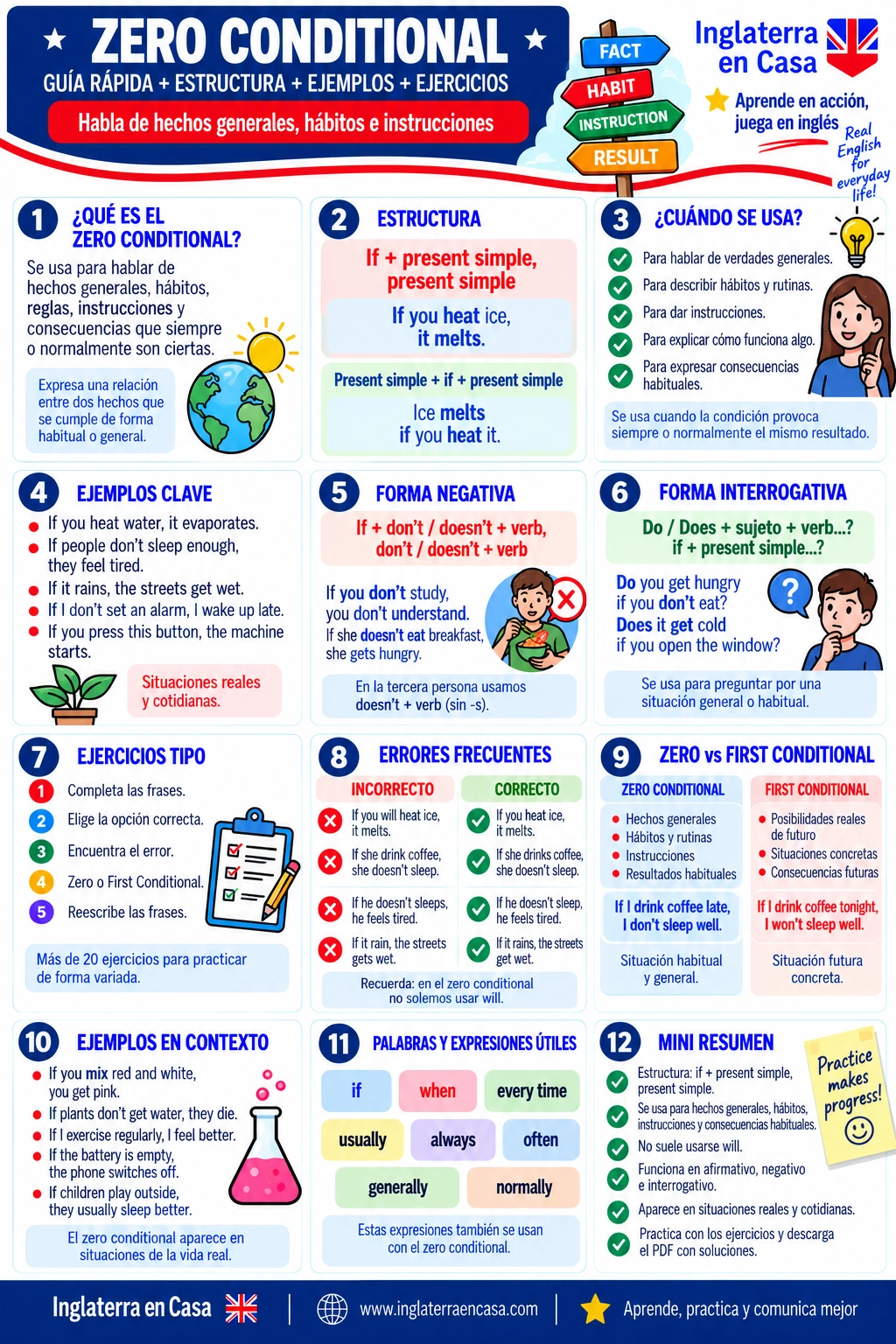
If + present simple, present simple
Esto significa que tanto la condición como su consecuencia se construyen normalmente con present simple.
If + sujeto + present simple, sujeto + present simple.
Por ejemplo:
- If you heat water, it evaporates.
- If people don’t sleep enough, they feel tired.
- If I drink coffee late, I don’t sleep well.
- If plants don’t get water, they die.
Una de las claves para resolver correctamente los Zero conditional exercises es recordar que normalmente no necesitamos utilizar will. Estamos hablando de una consecuencia general o habitual, no de una predicción concreta sobre el futuro.
¿Cuándo utilizamos el zero conditional?
Aprender la estructura resulta mucho más fácil cuando comprendemos qué queremos comunicar. El condicional cero aparece en diferentes situaciones de la vida cotidiana y no solamente en ejemplos científicos.
Hechos generales y verdades científicas
Es uno de sus usos más reconocibles. La condición provoca un resultado que presentamos como general.
- If you cool water enough, it freezes.
- If plants don’t get light, they die.
- Metal expands if you heat it.
Hábitos y rutinas
También podemos utilizar el zero conditional para explicar qué hacemos habitualmente cuando ocurre determinada situación.
- If I finish work early, I walk home.
- If Marta feels tired, she goes to bed early.
- If we have time, we usually cook together.
En estos casos no estamos afirmando que el resultado sea una ley universal. Explicamos una relación que se cumple de forma habitual para esa persona.
Instrucciones y funcionamiento
El condicional cero resulta especialmente útil para explicar instrucciones sencillas o cómo funciona algo.
- If the screen freezes, restart the computer.
- If you press this button, the machine starts.
- If the battery is empty, the phone switches off.
Consecuencias habituales
También podemos utilizar esta estructura cuando sabemos por experiencia que una situación suele producir una determinada consecuencia.
- If he skips breakfast, he gets hungry before lunch.
- If I don’t set an alarm, I wake up late.
- If she drinks milk, she feels sick.
¿Puede cambiarse el orden de la frase?
Sí. Una cuestión importante antes de empezar los Zero conditional exercises es saber que podemos colocar primero la condición o el resultado.
If I drink coffee late, I don’t sleep well.
También podemos decir:
I don’t sleep well if I drink coffee late.
El significado esencial no cambia. Sin embargo, hay una pequeña diferencia de puntuación: cuando comenzamos con la cláusula introducida por if, utilizamos normalmente una coma para separar las dos partes.
If it rains, the streets get wet.
Cuando la cláusula con if aparece después, normalmente no necesitamos la coma:
The streets get wet if it rains.
Zero conditional en negativo
Las dos partes de la oración pueden construirse también en negativo. Para ello aplicamos las reglas normales del present simple.
- If I don’t sleep enough, I don’t feel well.
- If he doesn’t study, he doesn’t understand the lesson.
- If plants don’t get water, they don’t grow properly.
Recuerda especialmente la tercera persona: utilizamos doesn’t + infinitivo sin to. Por tanto, decimos doesn’t work y no doesn’t works.
Zero conditional y los demás condicionales en inglés
El zero conditional forma parte de un grupo de estructuras que permiten expresar distintos grados de realidad, posibilidad e hipótesis. Diferenciarlas por su significado resulta más útil que limitarse a memorizar fórmulas.
Zero conditional: hechos y situaciones generales
If you don’t water plants, they die.
Presentamos la consecuencia como algo general.
First conditional: posibilidades reales de futuro
If it rains tomorrow, we’ll stay home.
Aquí hablamos de una situación futura posible. Si quieres practicar esta estructura por separado, puedes continuar con nuestros ejercicios de First Conditional en PDF.
Second conditional: situaciones hipotéticas
If I had more time, I would learn another language.
La situación se presenta como imaginaria, hipotética o poco probable. Puedes trabajarla con nuestros ejercicios de Second Conditional en PDF y con soluciones.
Third conditional: situaciones imposibles de cambiar en el pasado
If I had studied more, I would have passed the exam.
Estamos imaginando un resultado diferente para una situación que ya ocurrió. Para practicarlo específicamente tienes nuestros Third Conditional exercises en PDF.
Diferencia entre zero conditional y first conditional
Esta es probablemente la confusión más importante que debemos resolver. Las dos estructuras pueden utilizar if y hablar de una condición, pero la intención es diferente.
Zero conditional:
If I drink coffee at night, I don’t sleep well.
Estoy explicando lo que me ocurre habitualmente.
First conditional:
If I drink coffee tonight, I won’t sleep well.
Estoy hablando de una situación concreta que puede ocurrir esta noche y de su posible consecuencia futura.
Por eso no conviene elegir un condicional únicamente observando las palabras de la frase. Primero debemos entender qué quiere expresar la persona.
Errores frecuentes al hacer Zero conditional exercises
Utilizar will automáticamente
Incorrecto: If water reaches 0°C, it will freeze.
Correcto como afirmación general: If water reaches 0°C, it freezes.
El error suele producirse porque asociamos la palabra española “si” con una consecuencia futura. Sin embargo, en el zero conditional ambas partes suelen construirse en presente.
Olvidar la tercera persona del singular
Incorrecto: If she feels tired, she go to bed.
Correcto: If she feels tired, she goes to bed.
Usar doesn’t y mantener la -s del verbo
Incorrecto: If he doesn’t sleeps, he feels tired.
Correcto: If he doesn’t sleep, he feels tired.
Confundir una rutina con una situación futura concreta
Compara estas dos frases:
If I’m tired, I go to bed early.
If I’m tired tonight, I’ll go to bed early.
La primera explica un comportamiento habitual. La segunda plantea una posibilidad para esta noche.
Zero Conditional Exercises
Ejercicio 1: completa las frases
- If you heat water to 100°C, it ________ (boil).
- If people don’t sleep enough, they ________ (feel) tired.
- If ice gets warm, it ________ (melt).
- If I eat too quickly, I ________ (feel) ill.
- Plants ________ (die) if they don’t get water.
- If you press this button, the machine ________ (start).
- If my brother cooks, he always ________ (make) a mess.
- If it rains a lot, the ground ________ (get) wet.
- If children are hungry, they often ________ (become) irritable.
- If you don’t charge the battery, it ________ (die).
- Metal ________ (expand) when you heat it.
- If she drinks milk, she ________ (feel) sick.
- If we leave food outside in summer, it ________ (go) bad.
- If the sun sets, it ________ (get) dark.
- If I don’t set an alarm, I ________ (wake up) late.
- If you mix red and white, you ________ (get) pink.
- If dogs are frightened, they sometimes ________ (bark).
- If he exercises regularly, he ________ (feel) better.
- If you don’t water this plant, its leaves ________ (droop).
- If students practise regularly, they ________ (improve).
Ejercicio 2: elige la opción correcta
- If you don’t eat / won’t eat, you get hungry.
- If Sarah is / will be tired, she goes to bed early.
- Water freezes / will freeze if the temperature falls sufficiently.
- If we have / will have time, we usually walk.
- If Tom doesn’t wear / won’t wear his glasses, he can’t read the board.
- If cats feel / will feel threatened, they sometimes hiss.
- My phone switches / will switch off if the battery is empty.
- If I drink / will drink tea at night, I sleep well.
- If the shop closes / will close, we go somewhere else.
- If you add / will add sugar, the tea tastes sweeter.
- If Marta misses / will miss breakfast, she gets hungry early.
- People sweat / will sweat when they get very hot.
- If the road is / will be icy, cars move more slowly.
- If he doesn’t study / won’t study, he doesn’t understand the lesson.
- If you touch / will touch fire, it burns.
- The printer stops / will stop if it runs out of paper.
- If I’m / I’ll be stressed, I go for a walk.
- If children play / will play outside, they usually sleep better.
- Chocolate melts / will melt if it gets hot.
- If we don’t recycle / won’t recycle, we produce more waste.
Ejercicio 3: encuentra el error
Todas estas frases contienen al menos un error relacionado con el uso del zero conditional. Localízalo y escribe la frase correctamente.
- If you will heat ice, it melts.
- If she drink coffee late, she doesn’t sleep.
- Plants dies if they don’t get water.
- If I am hungry, I eats something.
- If he don’t exercise, he feels tired.
- Water boil if you heat it enough.
- If the battery is empty, the phone turn off.
- If we mixes yellow and blue, we get green.
- If my dog hear a noise, it barks.
- If you don’t wears a coat, you get cold.
- If Anna is late she take a taxi.
- If people doesn’t drink water, they get thirsty.
- If I wake up early, I am usually have breakfast at seven.
- Glass break if you drop it.
- If the teacher asks a question, Pedro answer quickly.
- If you press this key, the program will opens.
- If it rain, the streets get wet.
- If she doesn’t sleeps enough, she feels tired.
- If we are tired, we goes home early.
- The alarm rings if someone open the door.
Preguntas frecuentes sobre el Zero Conditional
¿Qué es el zero conditional en inglés?
El zero conditional es una estructura utilizada para expresar hechos generales, hábitos, reglas, instrucciones y relaciones de causa y efecto que se consideran normalmente ciertas cuando se cumple una condición.
¿Cuál es la estructura del zero conditional?
La estructura más habitual es if + present simple, present simple. Por ejemplo: If you heat ice, it melts. El orden de las dos cláusulas puede cambiar sin modificar el significado esencial.
¿Se utiliza will en el zero conditional?
Normalmente no. Cuando expresamos una relación general, tanto la condición como el resultado suelen construirse en present simple. Utilizar will puede convertir la frase en una predicción o acercarla al significado del first conditional.
¿Cuál es la diferencia entre zero conditional y first conditional?
El zero conditional expresa situaciones generales o habituales, mientras que el first conditional suele utilizarse para hablar de una posibilidad futura real. If I drink coffee late, I don’t sleep expresa un resultado habitual; If I drink coffee tonight, I won’t sleep habla de una situación futura concreta.
¿Cómo puedo practicar el zero conditional?
Conviene combinar distintos tipos de ejercicios: completar verbos, elegir entre varias opciones, identificar errores y diferenciar el zero conditional de otros condicionales. También es útil crear ejemplos relacionados con hábitos y situaciones cotidianas.
¿Puedo descargar Zero conditional exercises en PDF?
Sí. En esta página puedes trabajar los ejercicios online y utilizar la versión en PDF para repasar la teoría, realizar los ejercicios sin conexión y consultar posteriormente las soluciones.
Ejercicios interactivos
Practica el zero conditional con estos ejercicios interactivos. Selecciona una respuesta y sabrás inmediatamente si has acertado. Si la opción es correcta aparecerá en verde; si no lo es, aparecerá en rojo junto con una pequeña pista para ayudarte a comprender el error.
Completa las frases con Zero Conditional
Elige la forma verbal correcta. Recuerda que la estructura habitual es if + present simple, present simple.
1. If you heat ice, it ___.
2. If people don't sleep enough, they ___ tired.
3. If Laura doesn't sleep enough, she ___ tired.
4. Plants ___ if they don't get water.
5. If you press this button, the machine ___.
6. If I don't set an alarm, I ___ up late.
¿Qué frase está correctamente escrita?
En este ejercicio no tienes que completar un hueco. Lee las tres oraciones y selecciona la única opción correcta.
7. Elige la frase correcta.
8. Elige la frase correcta.
9. Elige la frase correcta.
10. Elige la frase correcta.
11. Elige la frase correcta.
12. Elige la frase correcta.
Zero Conditional o First Conditional
Decide si cada oración expresa una situación general o habitual (Zero Conditional) o una posibilidad futura concreta (First Conditional).
13. If I don't set an alarm, I usually wake up late.
14. If it rains tomorrow, we'll stay at home.
15. If people exercise regularly, they feel better.
16. If I finish early tonight, I'll call you.
17. If the battery runs out, the device switches off.
18. If Sarah arrives late tomorrow, we'll start without her.
Encuentra el error
La frase que aparece en cada pregunta contiene un error. Selecciona la única corrección adecuada.
19. “If she drink milk, she feels sick.”
20. “If he doesn't sleeps, he feels tired.”
21. “Water boil if you heat it.”
22. “If people doesn't eat, they get hungry.”
23. “If you press this button, the machine start.”
24. “If it rain, the streets get wet.”
Ejercicios de first conditional
A continuación tienes tres bloques de práctica. Intenta resolverlos antes de consultar las soluciones. Los primeros ejercicios de first conditional trabajan la forma verbal, el segundo bloque obliga a construir la relación entre condición y resultado y el tercero se centra en detectar errores frecuentes.
Bloque 1. Completa las oraciones con la forma correcta
- If it ________ (rain) tomorrow, we will stay at home.
- If you ________ (study) every day, you will improve your English.
- She will call you if she ________ (finish) early.
- If we ________ (leave) now, we will catch the bus.
- If Tom ________ (not hurry), he will be late.
- I will help you if I ________ (have) enough time.
- If they ________ (win) the match, they will celebrate tonight.
- If Marta ________ (see) Leo, she will give him the message.
- We ________ (not go) to the beach if the weather is bad.
- If your brother ________ (call), tell him I am at work.
- If you ________ (not charge) your phone, it will run out of battery.
- They will miss the train if they ________ (not leave) soon.
- If I ________ (find) your keys, I will text you.
- If the shop ________ (be) open, we will buy some bread.
- You ________ (feel) better if you get some rest.
- If Sara ________ (not practise), she will not pass the driving test.
- We ________ (start) dinner when Dad arrives.
- If the children ________ (be) tired, they will go to bed early.
- If you ________ (send) me the document, I will check it tonight.
- He ________ (not understand) the instructions unless you explain them clearly.
Bloque 2. Reescribe las ideas utilizando el first conditional
Convierte cada pareja de ideas en una sola oración con if. En algunos casos hay más de una respuesta posible; las soluciones ofrecen un modelo correcto.
- I may be tired tomorrow. In that case, I will stay at home.
- You must leave now. Otherwise, you will miss the train.
- Perhaps Laura comes to the party. Then I will introduce you to her.
- Take an umbrella. It might rain later.
- Study regularly. Then your vocabulary will improve.
- Maybe the restaurant is full. We will eat somewhere else.
- Do not touch that pan. You will burn yourself.
- The weather may improve. Then we will go for a walk.
- Perhaps I finish work before six. I will call you.
- You need to book today. Otherwise, you may not get a place.
- Maybe the children are hungry after school. I will make them a snack.
- He has to apologise. Otherwise, she will stay angry.
- Perhaps our flight is delayed. We will send you a message.
- You can ask me. I will explain the exercise again.
- Maybe we have enough money. We will buy the tickets today.
- Keep practising. Your pronunciation will get better.
- Perhaps the bus does not arrive soon. We will take a taxi.
- Maybe Anna does not answer. Leave her a message.
- Finish your homework first. Then you can play outside.
- Maybe they invite us. We will go to the wedding.
Bloque 3. Encuentra el error
Todas estas frases contienen al menos un error relacionado con el first conditional. Localízalo y escribe la oración correctamente.
- If it will rain tomorrow, we will cancel the picnic.
- If you will study more, you will pass the exam.
- She will be happy if you will call her.
- If he don’t hurry, he will miss the bus.
- If they arrives early, we will start at six.
- If I see Marta, I tell her the news.
- We will goes to the park if the weather is nice.
- If you won’t eat breakfast, you will be hungry later.
- Unless you don’t leave now, you will be late.
- If she finish early, she will meet us.
- If the shop will be open, I will buy some milk.
- You will feel better if you will sleep more.
- If we not book today, we may lose the offer.
- If he calls me, I will to answer immediately.
- If the baby will wake up, I will make a bottle.
- If you press this button, the machine will starts.
- We won’t go unless it doesn’t stop raining.
- If my sister come tonight, we will order pizza.
- If you are late, will miss the beginning.
- If they don’t practise, they not will improve.
Preguntas frecuentes sobre los ejercicios de first conditional
¿Qué es el first conditional en inglés?
El first conditional se usa para hablar de una condición real o posible en el presente o el futuro y de una consecuencia probable. La estructura más habitual es if + present simple, will + verbo en forma base.
¿Cuál es la estructura del first conditional?
La estructura básica es If + present simple, will + verbo base. También puede invertirse el orden: will + verbo base + if + present simple. Cuando la oración empieza por la cláusula con if, normalmente se escribe una coma entre las dos partes.
¿Se puede usar will después de if en el first conditional?
En el uso básico del first conditional, no se emplea will para expresar el futuro dentro de la cláusula con if. Se usa present simple: If it rains, we will stay at home. Existen usos especiales de will con otros valores, pero no son necesarios para dominar esta estructura.
¿Qué diferencia hay entre zero conditional y first conditional?
El zero conditional expresa hechos generales, rutinas o resultados que se consideran siempre verdaderos. El first conditional habla de una posibilidad concreta y realista, normalmente futura. Por ejemplo: If you heat ice, it melts; frente a If it rains tomorrow, we will stay at home.
¿Qué diferencia hay entre first conditional y second conditional?
El first conditional presenta una situación posible o realista: If I have time, I will call you. El second conditional plantea una situación hipotética, improbable o imaginaria: If I had more time, I would travel more.
¿Cómo se usa unless con el first conditional?
Unless significa normalmente if not. Por eso, Unless you hurry, you will miss the bus equivale a If you do not hurry, you will miss the bus. No conviene añadir otra negación después de unless en este tipo de frase.
¿Puedo cambiar el orden de las dos cláusulas?
Sí. If you study, you will pass the exam y You will pass the exam if you study expresan la misma relación. La diferencia principal es de énfasis y puntuación: si la cláusula con if va primero, se suele separar con una coma.
¿Qué incluyen estos ejercicios de first conditional en PDF?
El PDF incluye un marco teórico, ejemplos, un resumen visual, ejercicios de práctica, una sección para encontrar errores y las soluciones al final. Está pensado para que el alumno pueda estudiar la estructura y comprobar después sus respuestas de forma autónoma.
Soluciones de los ejercicios de first conditional
Compara tus respuestas solo después de haber completado cada bloque. En el segundo bloque pueden existir otras formulaciones correctas si mantienen el mismo significado y respetan la estructura.
Soluciones de los Zero Conditional Exercises
Soluciones del ejercicio 1
- boils
- feel
- melts
- feel
- die
- starts
- makes
- gets
- become
- dies
- expands
- feels
- goes
- gets
- wake up
- get
- bark
- feels
- droop
- improve
Soluciones del ejercicio 2
- don’t eat
- is
- freezes
- have
- doesn’t wear
- feel
- switches
- drink
- closes
- add
- misses
- sweat
- is
- doesn’t study
- touch
- stops
- I’m
- play
- melts
- don’t recycle
Soluciones del ejercicio 3: encuentra el error
- If you heat ice, it melts.
- If she drinks coffee late, she doesn’t sleep.
- Plants die if they don’t get water.
- If I am hungry, I eat something.
- If he doesn’t exercise, he feels tired.
- Water boils if you heat it enough.
- If the battery is empty, the phone turns off.
- If we mix yellow and blue, we get green.
- If my dog hears a noise, it barks.
- If you don’t wear a coat, you get cold.
- If Anna is late, she takes a taxi.
- If people don’t drink water, they get thirsty.
- If I wake up early, I usually have breakfast at seven.
- Glass breaks if you drop it.
- If the teacher asks a question, Pedro answers quickly.
- If you press this key, the program opens.
- If it rains, the streets get wet.
- If she doesn’t sleep enough, she feels tired.
- If we are tired, we go home early.
- The alarm rings if someone opens the door.