
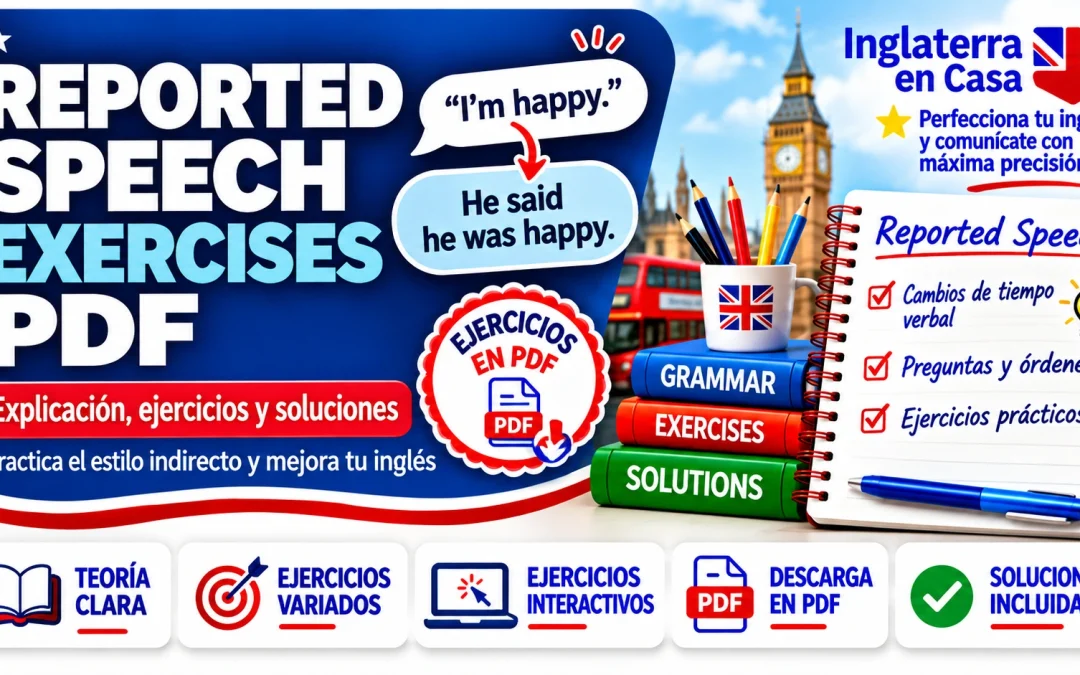
Reported speech exercises PDF: Ejercicios interactivos y con soluciones
El reported speech, o estilo indirecto, permite explicar lo que alguien ha dicho sin reproducir sus palabras literalmente. Si buscas reported speech exercises PDF, aquí encontrarás una guía práctica, ejemplos explicados, actividades autocorregibles y un cuaderno descargable con soluciones. El objetivo es que comprendas las reglas y sepas aplicarlas en conversaciones reales y exámenes de inglés.
¿Qué es el reported speech y para qué sirve?
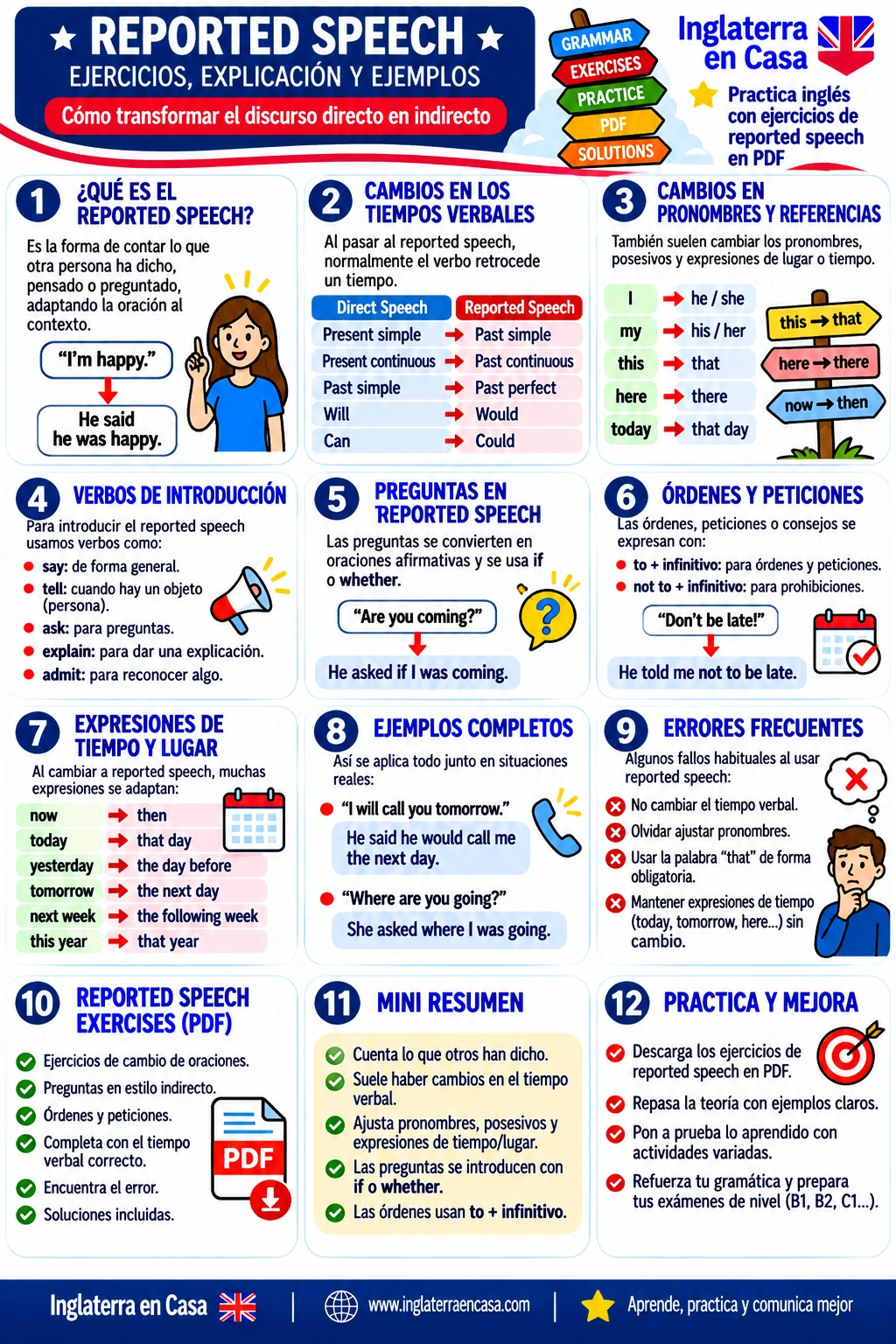
En el direct speech citamos literalmente: “I am happy,” she said. En estilo indirecto transmitimos el mensaje: She said (that) she was happy. Es habitual al contar noticias, resumir conversaciones, explicar instrucciones o describir preguntas de otras personas.
Cómo pasar de direct speech a reported speech paso a paso
1. Identifica quién habla y a quién se dirige
Antes de transformar la oración, determina la persona que habla, el destinatario y el momento de referencia. Así evitarás errores de pronombres y posesivos: my puede convertirse en her, his o their, según el contexto.
2. Escoge el verbo introductor: say, tell, ask
Utiliza say para transmitir información (She said that…), tell cuando expresas a quién se le comunicó (She told me that…) y ask para preguntas o peticiones (He asked whether…, She asked me to…). Evita she said me y she told that sin objeto.
3. Ajusta el tiempo verbal cuando corresponda
Si el verbo introductor está en pasado, es frecuente el backshift: present simple pasa a past simple, present continuous a past continuous y present perfect a past perfect. No es una regla automática: si el hecho sigue siendo cierto, puede conservarse el tiempo original.
| Direct speech | Reported speech habitual | Ejemplo |
|---|---|---|
| Present simple | Past simple | “I work” → He said he worked. |
| Present continuous | Past continuous | “I am working” → He said he was working. |
| Past simple | Past perfect | “I worked” → He said he had worked. |
| Present perfect | Past perfect | “I have worked” → He said he had worked. |
| Past continuous | Past perfect continuous | “I was working” → He said he had been working. |
| Will / can / may | Would / could / might | “I can help” → She said she could help. |
4. Revisa pronombres, lugar y tiempo
Las expresiones temporales dependen del momento en el que se cuenta el mensaje: now → then, today → that day, yesterday → the day before, tomorrow → the following day, here → there y this → that. No cambies estas expresiones si el contexto original sigue siendo el mismo.
Reported statements: afirmaciones y negaciones
La estructura más habitual es subject + said (that) + clause o subject + told + person + (that) + clause. La palabra that es opcional en muchos casos. Ejemplo: “I don’t understand,” Mia said → Mia said (that) she didn’t understand.
Reported questions: preguntas indirectas
Preguntas con what, where, why, when y how
Mantén la palabra interrogativa y utiliza orden de afirmación: “Where do you live?” → She asked where I lived. No escribas she asked where did I live. El auxiliar do/does/did normalmente desaparece al transformar la pregunta.
Preguntas de sí o no con if o whether
Si no existe palabra interrogativa, introduce la subordinada con if o whether: “Are you ready?” → He asked if I was ready. Whether suele ser útil cuando se presentan alternativas.
Reported commands, requests y consejos
Las órdenes y peticiones suelen transformarse con told/asked + person + (not) to + infinitive: “Open the door” → She told me to open the door; “Don’t move” → He told us not to move. Para consejos también pueden utilizarse verbos como advise, recommend o suggest, cada uno con su propia estructura.
Casos especiales y errores frecuentes
Verdades generales y situaciones que siguen vigentes
“Water boils at 100°C at sea level,” the teacher said → The teacher said water boils at 100°C at sea level. Mantener el presente es natural porque la afirmación sigue siendo válida. El contexto determina si se hace o no el cambio de tiempo.
Past perfect, could, would y should
El past perfect normalmente no retrocede más. Could, would y should también suelen mantenerse. Por ejemplo, “I had already left” → She said she had already left.
Los cinco errores que debes evitar
Confundir say/tell; mantener el orden interrogativo en preguntas indirectas; olvidar el objeto tras tell; usar don’t en lugar de not to en órdenes negativas; y aplicar cambios temporales sin considerar quién habla, cuándo y dónde.
Cómo estudiar con estos reported speech exercises en PDF
Lee primero las tablas y los ejemplos. Después resuelve las actividades sin consultar las respuestas, anota tus errores y repite los casos más difíciles. Puedes descargar los reported speech exercises PDF para imprimirlos o trabajarlos sin conexión. En la versión web también encontrarás ejercicios interactivos con corrección inmediata.
Practica el reported speech para Cambridge B1 y B2
El estilo indirecto es especialmente útil para ejercicios de transformación, redacciones y tareas de expresión oral. En los exámenes de Cambridge importa tanto la precisión gramatical como el uso adecuado de la estructura en contexto. En Inglaterra en Casa trabajamos la gramática mediante actividades comunicativas y clases presenciales en Marxalenes y Mislata, además de preparar a estudiantes para exámenes oficiales.
Descarga el cuaderno: Reported speech exercises PDF con teoría, ejercicios y soluciones. Ajusta esta URL a la ubicación real del archivo después de subirlo a WordPress.
Ejercicios de reported speech con soluciones
Resuelve estas 40 actividades antes de consultar el solucionario. Los ejercicios se organizan en cuatro bloques de diez. Soluciones al final de este artículo.
Transforma las afirmaciones
- “I am tired,” Lucy said.
- “We have finished,” they said.
- “I will call you,” Mark said to Anna.
- “I can swim,” Ben said.
- “I bought a bike,” Mia said.
- “We are studying,” the students said.
- “I must leave now,” Tom said.
- “I have been waiting,” Eva said.
- “This is my coat,” Olivia said.
- “I saw him yesterday,” Leo said.
Convierte las preguntas
- “Where do you live?” she asked me.
- “Are you ready?” the teacher asked.
- “What time does it start?” he asked.
- “Did you see the film?” Ana asked me.
- “Why are they laughing?” she asked.
- “Have you eaten?” Mum asked.
- “Can you help me?” Joe asked.
- “Who wrote this?” he asked.
- “Will it rain?” they asked.
- “When did you arrive?” she asked him.
Reformula órdenes y peticiones
- “Close the window,” Dad told me.
- “Don’t be late,” she said to us.
- “Please wait here,” the nurse said.
- “Don’t touch that,” he told the children.
- “Sit down,” the teacher said to Sara.
- “Please speak slowly,” I said to him.
- “Don’t forget your keys,” Mum said.
- “Turn left,” the guide told us.
- “Please help me,” she said to Max.
- “Don’t open the box,” the guard said.
Encuentra el error
- He said me that he was busy.
- She asked where did I live.
- They told to us to leave.
- He said he will come the next day.
- Anna asked me if was I tired.
- The teacher told us don’t talk.
- She said that she is ill yesterday.
- He asked me what time was it.
- She told that she had lost her phone.
- He asked me to not move.
Ejercicios interactivos
Reported speech exercises interactivos: practica y comprueba tus respuestas
Selecciona una respuesta en cada pregunta. La corrección aparece inmediatamente. Cada actividad contiene 20 preguntas.
Afirmaciones: elige la transformación correcta (20 preguntas)
Preguntas indirectas: selecciona la opción (20 preguntas)
Órdenes y peticiones: completa la estructura (20 preguntas)
Detecta la frase correcta (20 preguntas)
Preguntas frecuentes sobre reported speech exercises PDF
¿Qué es el reported speech en inglés?
Es el estilo indirecto: una forma de contar lo que otra persona dijo sin repetir necesariamente sus palabras exactas.
¿Cuándo cambian los tiempos verbales en reported speech?
Cuando el verbo introductor está en pasado suele producirse un desplazamiento temporal, aunque no siempre es obligatorio si la información sigue vigente.
¿Cuál es la diferencia entre say y tell?
Tell normalmente requiere un complemento de persona, como told me; say puede utilizarse sin él, como said that.
¿Cómo se transforman las preguntas al estilo indirecto?
Se utiliza el orden de una afirmación, sin inversión auxiliar-sujeto; las preguntas de sí o no suelen introducirse con if o whether.
¿Dónde encontrar reported speech exercises PDF con soluciones?
En esta página puedes consultar la explicación, practicar online y descargar un PDF con ejercicios y respuestas al final.
¿Cómo se transforman las órdenes negativas?
Se suele usar told o asked + persona + not to + infinitivo, por ejemplo: She told me not to wait.
¿Siempre cambia will por would?
No. Es frecuente con un verbo introductor en pasado, pero el cambio depende del contexto y de si se mantiene la referencia futura.
¿Qué nivel necesito para practicar estos ejercicios?
La guía sirve especialmente para B1 y B2, con observaciones útiles para estudiantes que preparan exámenes de Cambridge.
Soluciones: Transforma las afirmaciones
- Lucy said (that) she was tired.
- They said (that) they had finished.
- Mark told Anna (that) he would call her.
- Ben said (that) he could swim.
- Mia said (that) she had bought a bike.
- The students said (that) they were studying.
- Tom said (that) he had to leave then.
- Eva said (that) she had been waiting.
- Olivia said (that) that was her coat.
- Leo said (that) he had seen him the day before.
Soluciones: Convierte las preguntas
- She asked me where I lived.
- The teacher asked if/whether we were ready.
- He asked what time it started.
- Ana asked me if/whether I had seen the film.
- She asked why they were laughing.
- Mum asked if/whether I had eaten.
- Joe asked if/whether I could help him.
- He asked who had written that.
- They asked if/whether it would rain.
- She asked him when he had arrived.
Soluciones: Reformula órdenes y peticiones
- Dad told me to close the window.
- She told us not to be late.
- The nurse asked us to wait there.
- He told the children not to touch that.
- The teacher told Sara to sit down.
- I asked him to speak slowly.
- Mum reminded me not to forget my keys.
- The guide told us to turn left.
- She asked Max to help her.
- The guard told us not to open the box.
Soluciones: Encuentra el error
- He told me that he was busy. / He said that he was busy.
- She asked where I lived.
- They told us to leave.
- He said he would come the next day.
- Anna asked me if I was tired.
- The teacher told us not to talk.
- She said that she had been ill the day before. (Context-dependent alternatives are possible.)
- He asked me what time it was.
- She said that she had lost her phone. / She told me that she had lost her phone.
- He asked me not to move.