
Relative clauses exercises: teoría, ejemplos y ejercicios con soluciones
Esta guía de relative clauses exercises combina explicaciones claras, ejemplos, actividades graduadas y un PDF descargable con soluciones. Aprenderás a distinguir las oraciones de relativo especificativas y explicativas, elegir correctamente los pronombres relativos y evitar errores habituales en inglés.
Puedes utilizar los ejercicios de relative clauses para estudiar por tu cuenta, reforzar lo aprendido en clase o preparar pruebas de nivel y exámenes Cambridge. Los ejemplos avanzan desde estructuras básicas hasta usos formales de nivel superior.
Aprende inglés con Inglaterra en Casa
En Inglaterra en Casa reforzamos la gramática mediante clases presenciales participativas con profesores nativos, actividades prácticas y preparación de Cambridge. También organizamos programas intensivos y propuestas de inmersión en inglés para niños y jóvenes. Consulta nuestras opciones formativas en Valencia y Mislata.
Guía de relative clauses: conceptos esenciales
Qué son las relative clauses
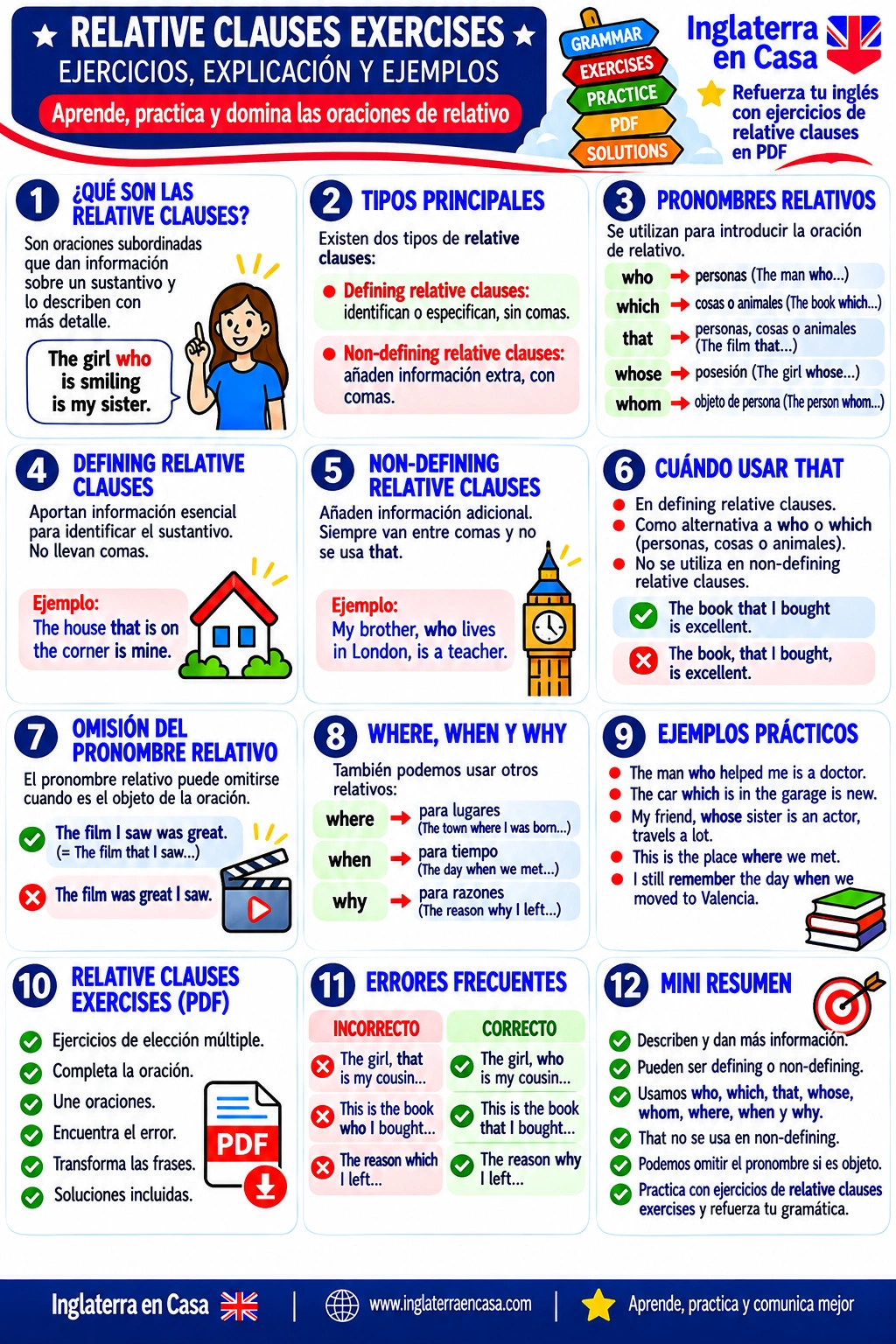
Las relative clauses son oraciones subordinadas que describen o identifican un sustantivo. Permiten unir ideas y evitar repeticiones. Por ejemplo: The girl is my friend. She lives next door. → The girl who lives next door is my friend.
Defining relative clauses: información imprescindible
Identifican exactamente de quién o de qué hablamos: The students who practise regularly improve faster. No llevan comas. Podemos utilizar who, which, that, whose, where y when según el contexto.
Consejo: compara The students who passed received a certificate (solo quienes aprobaron) con The students, who passed, received a certificate (todos aprobaron; información adicional).
Non-defining relative clauses: información adicional
Añaden información secundaria y se separan mediante comas: My brother, who lives in Manchester, is visiting. Si eliminamos la subordinada, la oración principal sigue identificando a la persona. Nunca se usa that en este tipo de estructura.
Who, whom, which y that
Who se refiere a personas; whom se utiliza formalmente cuando es objeto, especialmente tras una preposición; which se refiere a cosas o animales; that puede referirse a personas o cosas en defining clauses. Ejemplo: The teacher (who/whom/that) I met was friendly.
| Relativo | Uso habitual | Ejemplo |
|---|---|---|
| who | personas | The woman who called is here. |
| which | cosas o animales | The film which won was excellent. |
| that | personas o cosas (defining) | The book that I read was useful. |
| whose | posesión | The man whose car broke down called. |
| where | lugares | The café where we met has closed. |
| when | momentos | The day when we met was sunny. |
| whom | objeto formal | The person to whom I wrote replied. |
Whose: expresar posesión
Whose equivale a cuyo, cuya, cuyos o cuyas. No se limita a personas: The company whose offices were flooded reopened. La forma whose va seguida de un sustantivo.
Where, when y why
Where introduce lugares, when momentos y why razones: the school where I studied; the year when we met; the reason why I called. También podemos usar preposición + which en registros más formales: the school at which I studied.
Cuándo se omite el pronombre relativo
En defining clauses, si el relativo es objeto, se puede omitir: The film (which/that) we watched. Si es sujeto, no: The film that won the award. Tampoco puede omitirse en non-defining clauses.
Preposiciones y estilo formal
En registros formales se puede anteponer la preposición: The colleague to whom I spoke; the topic about which we argued. En inglés cotidiano suele ir al final: The colleague I spoke to; the topic we argued about.
Errores frecuentes que debes evitar
No combines el relativo con un pronombre redundante: The man who I met him es incorrecto. No uses that en non-defining clauses ni confundas whose con who. Revisa si la subordinada identifica al referente o solo añade información.
Cómo practicar para Cambridge y mejorar tu writing
Trabaja primero la distinción entre defining y non-defining; después practica omisiones, posesión y preposiciones. En writing, las relative clauses aportan cohesión y precisión. Revisa siempre la puntuación, la función sintáctica y el registro.
Relative clauses exercises: actividades graduadas
Resuelve los siguientes bloques antes de consultar las respuestas. Cada bloque contiene veinte ejercicios distintos. En las frases con varias opciones correctas, el solucionario recoge alternativas válidas. Puedes descargar estos relative clauses exercises en PDF y repasar la teoría sin conexión.
Bloque 1: Completa con el relativo adecuado
- The woman ___ teaches us English is from Bristol.
- The book ___ I borrowed was fascinating.
- The café ___ we met is near the station.
- The boy ___ bike was stolen called the police.
- The day ___ we first met was unforgettable.
- The scientist ___ discovered the formula won a prize.
- The laptop ___ broke yesterday is under warranty.
- The family ___ lives next door has three dogs.
- The city ___ she grew up is very small.
- The actor ___ performance impressed us won an award.
- The reason ___ he resigned remains unclear.
- The students ___ finished early could leave.
- The painting ___ you bought looks beautiful.
- The hotel ___ we stayed had a pool.
- The colleague ___ advice helped me has retired.
- The summer ___ we moved abroad was very hot.
- The phone ___ is ringing belongs to Emma.
- The teacher ___ you spoke to is my aunt.
- The village ___ my grandparents live is remote.
- The musician ___ songs we love is touring.
Bloque 2: Une las frases con una relative clause
- My sister lives in Leeds. She is a doctor.
- The car is electric. I bought it last month.
- The boy won the race. His father is a coach.
- We visited a museum. It opened in 1890.
- That is the house. I was born there.
- I met a writer. Her novels are translated worldwide.
- Monday was the day. We received the results then.
- The man is my neighbour. He helped you.
- The film was excellent. We watched it yesterday.
- This is the restaurant. We celebrated there.
- Our headteacher is retiring. She has worked here for 30 years.
- The student passed. Her project was outstanding.
- I lost the key. It opens the garage.
- The park is beautiful. We walk there every weekend.
- The year was 2019. They moved to Spain then.
- The man is an engineer. I spoke to him.
- The woman is a pilot. Her daughter studies here.
- My laptop has stopped working. It is only six months old.
- The café has closed. We used to study there.
- The novel is on the shelf. You recommended it.
Bloque 3: Encuentra el error y corrige la frase
- My brother, that lives in London, is a nurse.
- The girl which won the prize is 15.
- This is the person which I told you about.
- The hotel who we stayed in was expensive.
- The woman who her bag was lost called reception.
- My car, that is red, is outside.
- The house where I bought is old.
- The man whose works here is my uncle.
- That is the day where we met.
- The book who is on the table is mine.
- She is the teacher whose teaches French.
- My father which is retired loves gardening.
- The restaurant when we ate was crowded.
- The reason where I left is personal.
- The boy who I met him is very friendly.
- The town which I was born is small.
- The student whose essay won she is here.
- The train, that was late, finally arrived.
- The woman which son is a doctor lives nearby.
- This is the place when we first kissed.
Bloque 4: Nivel avanzado: precisión y preposiciones
- The person ___ called is my tutor.
- The person ___ you called is my tutor.
- The building, ___ was renovated last year, is a library.
- The student ___ notes I borrowed is absent.
- The room ___ we practise speaking is upstairs.
- The year ___ I graduated was 2020.
- The reason ___ she complained was the noise.
- My aunt, ___ speaks Italian, lives in Rome.
- The jacket ___ I ordered arrived today.
- The neighbour ___ dog barks at night apologised.
- The woman to ___ I sent the email replied.
- The company for ___ I work is expanding.
- The street on ___ I live is quiet.
- The friends ___ invited us are very kind.
- The device ___ measures temperature is broken.
- The artist, ___ paintings are famous, is visiting.
- The city in ___ he studied is Oxford.
- The moment ___ I realised the mistake was embarrassing.
- The children ___ we met were polite.
- The reason for ___ they cancelled the trip was the weather.
Ejercicios interactivos
Relative clauses exercises interactivos
24 actividades en cuatro modalidades. Selecciona una respuesta: el color verde indica acierto y el rojo invita a intentarlo de nuevo.
Modalidad 1: Elige el relativo
1. The artist ___ painted this is famous.
¡Correcto!
Revisa la regla y prueba otra opción.
2. The house ___ roof is red is mine.
¡Correcto!
Revisa la regla y prueba otra opción.
3. The month ___ we moved was June.
¡Correcto!
Revisa la regla y prueba otra opción.
4. The shop ___ I work is nearby.
¡Correcto!
Revisa la regla y prueba otra opción.
5. The watch ___ I bought is broken.
¡Correcto!
Revisa la regla y prueba otra opción.
6. The woman ___ called is my boss.
¡Correcto!
Revisa la regla y prueba otra opción.
Modalidad 2: Defining o non-defining
1. My uncle, who lives in Bath, is a chef.
¡Correcto!
Revisa la regla y prueba otra opción.
2. The people who arrived late waited outside.
¡Correcto!
Revisa la regla y prueba otra opción.
3. The river, which is very long, crosses the city.
¡Correcto!
Revisa la regla y prueba otra opción.
4. The phone that I lost was expensive.
¡Correcto!
Revisa la regla y prueba otra opción.
5. Our coach, whose team won, was delighted.
¡Correcto!
Revisa la regla y prueba otra opción.
6. The books which are on sale are new.
¡Correcto!
Revisa la regla y prueba otra opción.
Modalidad 3: ¿Puede omitirse?
1. The man who lives here is a doctor.
¡Correcto!
Revisa la regla y prueba otra opción.
2. The film that we watched was funny.
¡Correcto!
Revisa la regla y prueba otra opción.
3. My sister, who works here, is happy.
¡Correcto!
Revisa la regla y prueba otra opción.
4. The shoes which I ordered arrived.
¡Correcto!
Revisa la regla y prueba otra opción.
5. The student whose essay won is here.
¡Correcto!
Revisa la regla y prueba otra opción.
6. The song that topped the charts is catchy.
¡Correcto!
Revisa la regla y prueba otra opción.
Modalidad 4: Detecta la frase correcta
1. Elige la opción gramatical.
¡Correcto!
Revisa la regla y prueba otra opción.
2. Elige la opción gramatical.
¡Correcto!
Revisa la regla y prueba otra opción.
3. Elige la opción gramatical.
¡Correcto!
Revisa la regla y prueba otra opción.
4. Elige la opción gramatical.
¡Correcto!
Revisa la regla y prueba otra opción.
5. Elige la opción gramatical.
¡Correcto!
Revisa la regla y prueba otra opción.
6. Elige la opción gramatical.
¡Correcto!
Revisa la regla y prueba otra opción.
Nota: la corrección visual es inmediata y no guarda puntuaciones ni envía datos.
Preguntas frecuentes sobre relative clauses exercises
¿Qué son las relative clauses en inglés?
Son oraciones subordinadas que aportan información sobre una persona, cosa, lugar, momento o posesión. Pueden identificar al referente o añadir un dato complementario.
¿Cuál es la diferencia entre defining y non-defining relative clauses?
Las defining identifican a la persona o cosa de la que hablamos y no llevan comas. Las non-defining añaden información no esencial, van entre comas y no admiten that como pronombre relativo.
¿Cuándo se usa who y cuándo which?
Who se emplea normalmente para personas; which, para cosas y animales. That puede sustituirlos en muchas defining relative clauses, pero no en non-defining.
¿Cuándo se puede omitir el pronombre relativo?
En una defining relative clause puede omitirse cuando funciona como objeto, como en The book (that) I bought. No se omite cuando es sujeto ni en non-defining clauses.
¿Qué diferencia hay entre whose y who?
Who se refiere a personas y puede actuar como sujeto u objeto; whose expresa posesión y va seguido de un sustantivo: the student whose project won.
¿Se puede usar that después de una coma?
No para introducir una non-defining relative clause. En ese caso se utiliza who, which o whose según corresponda.
¿Qué nivel tienen estos relative clauses exercises?
Los ejercicios avanzan desde estructuras habituales de A2-B1 hasta usos propios de B2-C1, como las preposiciones antes de whom o which.
¿Puedo descargar los ejercicios de relative clauses con soluciones?
Sí. El cuaderno PDF incluye un marco teórico, actividades graduadas y un solucionario al final para estudiar y autocorregirse.
Soluciones del bloque 1
- who
- which / that / omission
- where
- whose
- when
- who
- which / that
- who / that
- where
- whose
- why
- who / that
- which / that / omission
- where
- whose
- when
- which / that
- who / whom / that / omission
- where
- whose
Soluciones del bloque 2
- My sister, who is a doctor, lives in Leeds.
- The car which/that I bought last month is electric.
- The boy whose father is a coach won the race.
- We visited a museum which/that opened in 1890.
- That is the house where I was born.
- I met a writer whose novels are translated worldwide.
- Monday was the day when we received the results.
- The man who/that helped you is my neighbour.
- The film which/that we watched yesterday was excellent.
- This is the restaurant where we celebrated.
- Our headteacher, who has worked here for 30 years, is retiring.
- The student whose project was outstanding passed.
- I lost the key which/that opens the garage.
- The park where we walk every weekend is beautiful.
- 2019 was the year when they moved to Spain.
- The man who/whom/that I spoke to is an engineer.
- The woman whose daughter studies here is a pilot.
- My laptop, which is only six months old, has stopped working.
- The café where we used to study has closed.
- The novel which/that you recommended is on the shelf.
Soluciones del bloque 3
- My brother, who lives in London, is a nurse.
- The girl who/that won the prize is 15.
- This is the person who/whom/that I told you about.
- The hotel which/that we stayed in was expensive.
- The woman whose bag was lost called reception.
- My car, which is red, is outside.
- The house which/that I bought is old.
- The man who/that works here is my uncle.
- That is the day when we met.
- The book which/that is on the table is mine.
- She is the teacher who/that teaches French.
- My father, who is retired, loves gardening.
- The restaurant where we ate was crowded.
- The reason why I left is personal.
- The boy who/that I met is very friendly.
- The town where I was born is small.
- The student whose essay won is here.
- The train, which was late, finally arrived.
- The woman whose son is a doctor lives nearby.
- This is the place where we first kissed.
Soluciones del bloque 4
- who / that
- who / whom / that / omission
- which
- whose
- where
- when
- why
- who
- which / that / omission
- whose
- whom
- which
- which
- who / that
- which / that
- whose
- which
- when
- who / whom / that / omission
- which